Enterprise IoT solutions with AI and Edge Intelligence
We design and build enterprise IoT systems that execute decisions across your operations.
SumatoSoft is a dual-engine engineering firm. We architect secure, scalable enterprise IoT networks and deploy machine learning models directly at the edge – turning continuous sensor data into immediate, automated actions inside your workflows.





Enterprise IoT development services
We design and implement enterprise AIoT solutions that operate reliably across distributed assets, high data volumes, and complex infrastructure. Each capability is engineered to work as part of a unified system, ensuring predictable performance and controlled scalability.

IT/OT convergence middleware
We connect operational technology and enterprise systems into a single architecture. Machine-level data from PLCs, SCADA, and industrial equipment is translated into structured, usable information for ERP, analytics platforms, and AI models.

Predictive machine learning and automated workflows
Besides classic IoT software development, we integrate machine learning models directly into operational processes. The system detects patterns in equipment behavior and executes predefined actions, supporting predictive maintenance and continuous operational adjustment.

Hardware-Agnostic Edge ETL
We process IoT data at the edge, close to where it is generated. Telemetry is filtered, structured, and prepared locally before reaching the cloud, ensuring consistent data quality and efficient data flow across the system.

Enterprise system integration
We integrate IoT data with your existing business systems. ERP, CRM, BI, and internal platforms receive structured data that can be used directly in planning, reporting, and operational workflows.

Scalable data pipelines and processing
We build data pipelines that handle high-frequency telemetry and large device fleets. Data ingestion, validation, processing, and storage are structured to maintain performance and consistency as the system grows.

Security and controlled system access
We implement security across devices, data, and system interactions. Authentication, access control, encryption, and auditability are built into the architecture, ensuring controlled system behavior at scale.
Enterprise IoT requires more than just code; it demands a deep understanding of business domains and a commitment to transparency. Our mission is to be the trusted technological partner that navigates you through complexity, ensuring security, interoperability, and continuous value delivery from day one.

Why enterprises choose SumatoSoft for IoT

Security embedded in delivery
SumatoSoft operates as an ISO-certified company (ISO 9001 and ISO 27001) and applies structured security practices across the entire delivery process. Access control, data protection, and compliance requirements are defined at the start and maintained throughout development, integration, and operation.

Proven experience in enterprise-scale systems
We bring over 14 years of experience in software development, with more than 100 engineers on board. Our team has delivered 300+ projects across 27 countries and 11 business domains, including complex enterprise IoT systems with distributed assets and high data volumes.

Full lifecycle responsibility
Enterprise Clients work with a single accountable partner across the entire system lifecycle. Our teams cover consulting, architecture design, development, integration, testing, cloud infrastructure, DevOps, and post-launch support, ensuring continuity and consistency from start to long-term operation.

Long-term partnership and system continuity
We focus on long-term cooperation and system evolution. 70% of our Clients return with additional projects, and our Client satisfaction rate reaches 98%. This reflects stable delivery, predictable outcomes, and alignment with business needs over time.

We work honestly and transparently
We maintain open communication throughout the project. Our teams provide clear recommendations, explain architectural decisions, and support informed decision-making, ensuring that every step of the system development remains aligned with your operational and strategic objectives.

Structured delivery with measurable progress
Each project is executed with defined milestones, regular reporting, and continuous visibility. We provide weekly updates, demonstrate delivered functionality, and maintain alignment with business goals throughout the project lifecycle.
Request a proposal
Receive a detailed project roadmap and budget estimation within 48 hours.
Our recent works


The system has produced a significant competitive advantage in the industry thanks to SumatoSoft’s well-thought opinions. They shouldered the burden of constantly updating a project management tool with a high level of detail and were committed to producing the best possible solution.

I was impressed by SumatoSoft’s prices, especially for the project I wanted to do and in comparison to the quotes I received from a lot of other companies.
Also, their communication skills were great; it never felt like a long-distance project. It felt like SumatoSoft was working next door because their project manager was always keeping me updated.

We tried another company that one of our partners had used but they didn’t work out. I feel that SumatoSoft does a better investigation of what we’re asking for. They tell us how they plan to do a task and ask if that works for us. We chose them because their method worked with us.

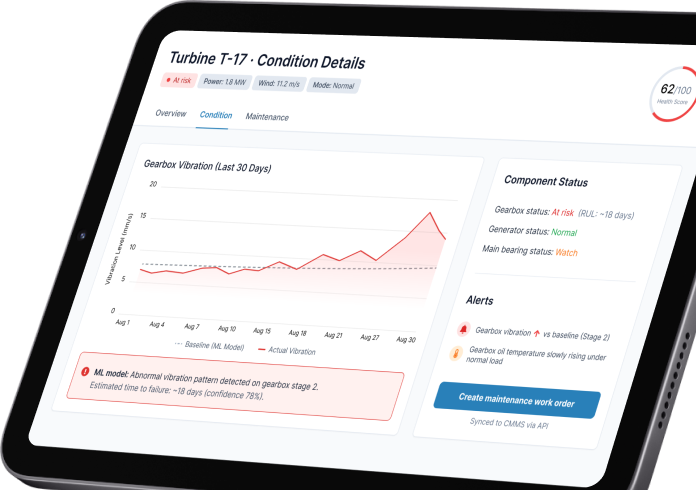
We brought in SumatoSoft to help us reduce unexpected turbine failures, and the result met our expectations. From the early stages, their team demonstrated a strong understanding of our business domain and the constraints of working with existing SCADA systems. They took a proactive approach, carefully analyzing our requirements and proposing a solution that enhanced our infrastructure without disrupting it. Communication was clear and structured, and the project was managed professionally, with all milestones delivered on time.

SumatoSoft is the firm to work with if you want to keep up to high standards. The professional workflows they stick to result in exceptional quality.
Important, they help you think with the business logic of your application and they don’t blindly follow what you are saying. Which is super important. Overall, great skills, good communication, and happy with the results so far.

Together with the team, we have turned the MVP version of the service into a modern full-featured platform for online marketers. We are very satisfied with the work the SumatoSoft team has performed, and we would like to highlight the high level of technical expertise, coherence and efficiency of communication and flexibility in work.
We can confidently say that SumatoSoft has put all our ideas into practice.

Rivalfox had the pleasure to work with SumatoSoft in building out core portions of our product, and the results really couldn’t have been better.
SumatoSoft provided us with engineering expertise, enthusiasm and great people that were focused on creating quality features quickly.

SumatoSoft succeeded in building a more manageable solution that is much easier to maintain. Their project management reflects the excellence of a larger company. Their team delivers high-quality results, attentive service, and reasonable pricing.

Thanks to SumatoSoft’s can-do attitude, amazing work ethic, and willingness to tackle clients’ problems as their own, they’ve become an integral part of our team. We’ve been truly impressed with their professionalism and performance and continue to work with the team on developing new applications.
We are completely satisfied with the results of our cooperation and will be happy to recommend SumatoSoft as a reliable and competent partner for development of web-based solutions

From the early stages of the project, SumatoSoft demonstrated a proactive attitude, actively seeking opportunities to enhance the solution and anticipate our needs. They consistently took the initiative to address any potential issues, provide timely updates, and offer solutions to challenges that arose during development. This proactiveness greatly contributed to the project’s success and exceeded our expectations.

Working with SumatoSoft has been an outstanding experience. Their team is not only highly skilled but also incredibly responsive, collaborative, and committed to delivering quality results. I can’t recommend them enough! Thank you team SumatoSoft for bringing my vision to life.

SumatoSoft is flexible, efficient, and extremely good at planning and being proactive. They have also been very proactive in their approach throughout the project, seeking to understand the needs and the reasons behind them before launching into development, which has been helpful for maintaining direction and consistency, especially because the end client is regularly generating new ideas for added features.

Industries we build enterprise IoT solutions for
Each AIoT enterprise solution we design is built around operations in your specific industry. We bring over a decade of expertise in 11 industries to ensure your AIoT system brings tangible benefits to your business.

Manufacturing and industrial operations
We develop AIoT solutions that unify equipment data across production lines and plants, enabling consistent operational control. Machine behavior is monitored continuously, and predictive models identify deviations before they affect throughput. Systems integrate directly with MES, ERP, and maintenance workflows, ensuring that operational decisions are based on real-time data.

Healthcare and medical devices
We develop IoT systems that support predictable operation, traceability, and controlled data access in regulated environments. Device data is structured and integrated into existing IT systems, enabling monitoring, reporting, and compliance workflows. Access control and auditability are embedded into the system architecture to support operational continuity.

Energy and utilities
We build enterprise IoT solutions that manage distributed infrastructure across large geographic areas with controlled data flow and centralized visibility. Telemetry from substations, grids, and field assets is collected, structured, and processed to support real-time monitoring, predictive maintenance, and operational planning. The system remains stable under variable connectivity and supports secure integration with enterprise systems.

Smart buildings and smart infrastructure
We connect building systems into a unified operational layer that supports monitoring, control, and optimization across facilities. HVAC, energy usage, access systems, and environmental sensors operate within one system, providing consistent visibility and enabling automated responses to changing conditions. The platform scales across multiple properties without increasing operational complexity.

Logistics and transportation
We design IoT platforms that maintain operational visibility across moving assets, routes, and hubs. Fleet data is processed in real time, allowing teams to track asset condition, location, and performance across regions. The enterprise IoT solution integrates with planning and reporting systems, enabling coordinated decision-making across logistics operations.

Retail and multi-location operations
We build enterprise IoT solutions that ensure consistent performance across distributed locations. Equipment, environmental conditions, and operational metrics are monitored centrally, allowing teams to manage multiple sites through a unified interface. The system supports scaling without introducing fragmentation or local inconsistencies.

Automotive and telematics
We design platforms that process continuous streams of data from vehicles and connected systems at scale. Telemetry is ingested, processed, and used to support real-time monitoring, performance analysis, and predictive maintenance. The system remains stable as fleet size and data volume grow, ensuring long-term reliability.

Industrial safety and environmental monitoring
We build enterprise IoT solutions where continuous data availability and traceability are required. Sensor data is collected and processed in real time, with structured event logging and alerting that supports compliance, incident response, and operational oversight. The system maintains reliability across environments and conditions.
Build Your IoT Team
Scale your capabilities with our pre-vetted senior IoT engineers and architects.
Enterprise IoT architecture
Enterprise IoT systems we develop are structured as interconnected layers that operate as one controlled system. Each layer has a defined role, clear interfaces, and stable interaction with the rest of the architecture, ensuring predictable behavior as the system scales.
Sensors and actuators
At the physical level, sensors and actuators capture signals and execute actions in real-world environments. Data originates here and reflects the actual state of equipment, assets, and conditions.
Devices
Our IoT solutions connect machines, controllers, and embedded devices that collect and transmit data. Devices operate reliably under real conditions and maintain consistent data flow across environments.
Abstraction layer or IoT gateway
Edge gateways normalize protocols, structure incoming data, and manage communication between devices and the platform. This layer handles local processing and supports stable operation under variable connectivity.
Infrastructure and integration layer
The core IoT platform includes backend services, APIs, data processing, analytics, and storage. This layer manages data flow, system logic, and integration across all components.
Application layer
Applications, dashboards, and system interfaces enable teams to monitor operations, access data, and execute decisions within existing business workflows.
Security across all layers
Authentication, encryption, access control, and audit logging are implemented across the entire system. Security is consistently applied at every layer to ensure controlled and reliable system operation.


Our expertise in tools and technologies
IoT connectivity and data ingestion
- MQTT
- AMQP
- HTTP / HTTPS
- WebSockets
- OPC UA
- Modbus
- AWS IoT Core
Data processing, storage, and operations
- Apache Kafka
- PostgreSQL
- InfluxDB
- TimescaleDB
- Docker
- Kubernetes
- Grafana
Backend and frontend development
- Java
- .NET
- Python
- Node.js
- PHP
- React.js
- Vue.js
- Django (server-rendered UI / admin interfaces)
- iOS/Android
- React Native
AI and machine learning
- Python
- TensorFlow
- PyTorch
AI-powered interaction with IoT solutions
 Direct interaction with IoT systems through natural language
 Controlled architecture behind AI interaction
Direct interaction with IoT systems through natural language
We design AI-powered interaction layers that allow your teams to work with this data directly, using natural language. Instead of navigating multiple tools, your operators, engineers, and managers can ask specific operational questions and receive structured, accurate answers based on live and historical data.
Examples of interaction:
- Which machines are showing early signs of performance degradation this week
- What is the current condition of assets across Facility B
- Where do we see abnormal temperature or vibration patterns right now

Controlled architecture behind AI interaction
This interaction layer is built on a structured and governed system design.
- IoT data is prepared for querying at the ingestion and processing stages
- Time-series data and events are organized for precise retrieval
- AI models operate within defined data boundaries and access rules
- Responses are generated based on actual system data
The result is a unified interaction layer that remains transparent, predictable, and aligned with your enterprise architecture while providing a faster and more direct way to access and use IoT data.

Talk to an enterprise IoT Expert
Schedule a free 30-minute technical consultation to discuss your challenges.
How AIoT solutions improve operational performance and cost efficiency
AIoT solutions operate directly inside your workflows, where data becomes immediate operational input. We design enterprise IoT solutions that process telemetry at the edge, structure it into usable signals, and connect it to your business processes in real time.

Reduce operational overhead through structured data flow
We build data pipelines that filter, validate, and structure high-frequency telemetry before it reaches your core systems. Your teams work with consistent, decision-ready data instead of raw streams.

Improve equipment performance and availability
We deploy predictive models that detect changes in machine behavior and support timely maintenance decisions. Equipment operates under controlled conditions, with fewer interruptions and more predictable performance.

Lower infrastructure and cloud costs
We implement edge processing that reduces unnecessary data transfer and storage. Only meaningful events and structured states are delivered to your cloud environment, keeping infrastructure efficient as the system scales.

Accelerate operational decision-making
We connect IoT data directly to ERP, CMMS, and internal systems. Signals are used inside existing workflows, enabling faster coordination across operations, maintenance, and management.
Awards & Recognitions






Let’s start
If you have any questions, email us info@sumatosoft.com

More about our Enterprise IoT Solutions

Frequently asked questions
How do you prevent streaming thousands of high-frequency sensors from bankrupting your cloud (AWS/Azure) budget?
Streaming raw telemetry to the cloud creates a massive “data gravity” problem. We engineer semantic edge-filtering. The local gateway analyzes the high-frequency data locally, discards the “normal” noise, and only transmits critical anomalies or aggregated state-changes to your cloud, cutting cloud ingress and compute costs by up to 90%.
How do you deploy machine learning models to remote IoT devices with low power and no internet connection?
We utilize model quantization and offline-first architectures. We compress massive cloud-based algorithms (using frameworks like TensorFlow Lite) so they can run efficiently on low-power edge gateways. The machine makes autonomous predictive decisions locally, and only transmits tiny payload summaries via LPWAN/LoRaWAN when a connection becomes available.
Can an LLM accurately analyze live, continuous time-series sensor data without hallucinating?
LLMs cannot read raw time-series data streams natively. We engineer a middleware pipeline that converts your high-frequency IoT data into a time-series vector database (like InfluxDB integrated with Pinecone). The LLM is then grounded using strict RAG pipelines, allowing it to accurately query historical trends and live sensor states without inventing numbers.
How do you secure an enterprise IoT network from being used as a backdoor by hackers?
We engineer zero-trust AIoT architectures. We utilize public key infrastructure (PKI) and mutual TLS (mTLS) for device authentication. Every edge gateway is provisioned with a unique cryptographic certificate stored in a secure hardware enclave (TPM). We design fail-safe over-the-air (OTA) firmware update pipelines with automated A/B partition fallbacks to ensure a bad update never “bricks” your fleet.
How do you use retrieval-augmented generation (RAG) on live IoT telemetry streams when LLMs usually require static documents?
We engineer a hybrid streaming RAG architecture. We use stream processors (like Apache Kafka) to monitor the live data. When an event occurs, an edge ML model generates a semantic summary of the event and vectorizes it. When your enterprise copilot is asked a question, it queries this vector database for the context and simultaneously queries a time-series database (like InfluxDB) for the exact numerical data, delivering answers that are both contextually aware and mathematically flawless.



