Brownfield integration services | IT/OT Convergence
Connect legacy machines, SCADA, PLCs, and plant systems to AI-ready data flows without replacing stable equipment or interrupting production. SumatoSoft designs edge middleware for brownfield plants. We extract trapped telemetry from older industrial systems, translate vendor-specific signals into a shared data model, and feed governed data into predictive ML, AI copilots, and agentic workflows.






What brownfield integration service does
Brownfield AIoT architecture connects existing OT assets to modern data and AI systems while keeping the working industrial core in place. We build the middleware layer between the factory floor and enterprise systems. This layer reads legacy signals, filters noisy telemetry, maps cryptic tags to business meaning, and sends curated data to the systems that need it.
Your existing PLCs, SCADA, MES, ERP, CMMS, and data platforms keep their roles. The new layer gives them a shared data foundation for predictive maintenance, anomaly detection, downtime analysis, and supervised AI workflows.

Operational technology
PLCs, sensors, machines, gateways, industrial networks: we collect signals from legacy and mixed-vendor equipment without changing how it runs.

Integration layer
Protocol translation, normalization, buffering, rules, edge computing: this layer turns device chatter into stable, versioned data your systems can trust.

IT and cloud
ERP, MES, SCADA, CMMS, data warehouse, BI, data lake, alerting, ticketing: we deliver telemetry and events where they drive actions, e.g., reports, maintenance, and operations.
Start your transformation
Ready to scale? Let’s discuss your legacy setup and build a custom IoT bridge today.


For 14+ years, we have proudly taken responsibility for your IoT projects!

Dual-engine delivery for industrial AI
SumatoSoft combines standard software engineering with AI delivery controls. The deterministic system layer follows conventional SDLC. The AI layer follows ADLC with data governance, model validation, prompt controls, evaluation sets, and human oversight.

Air-gapped AI & cyber-physical security
AI Intelligence without the Cyber Risk. You cannot expose a 20-year-old unpatched PLC to the public internet. We engineer Unidirectional Edge Gateways (Data Diodes). The legacy machine securely pushes data outbound to the Edge AI Gateway, but the architecture physically prevents any inbound traffic from the cloud, ensuring your critical infrastructure is 100% immune to remote ransomware while still fueling your cloud AI.

“Digital Twin Overlay” Strategy
How do you build a Digital Twin of a 1998 CNC machine? Through AI Sensor Fusion Overlays. We don’t just extract the limited data from the old PLC; we install non-invasive, secondary IoT sensors (acoustic microphones, thermal cameras, vibration accelerometers) on the chassis. Our Edge AI fuses the legacy PLC data with the modern sensor telemetry to create a perfect, real-time Digital Twin of your oldest assets.

Hardware-in-the-Loop (HITL) Simulation Guarantee
Never Test in Production. Before our edge middleware ever touches your live factory floor, we utilize Hardware-in-the-Loop (HITL) Simulation. We digitally simulate the exact electrical signals and protocol behaviors of your legacy machines in our labs. We validate that our AI gateways can safely extract the data under extreme stress without causing a microsecond of latency to your critical control loops.
Awards & Recognitions




Request a technical quote
Get a transparent breakdown of the costs and timelines involved in retrofitting your systems.
Benefits of IT/OT Convergence

Modernization without ripping out what still works
Legacy systems often stay in place for a reason. They run critical processes and have years of proven stability. IoT integration lets you add new data flows and automation around the core system while keeping its logic intact.

It’s not a multi-million rip-and-replace project
Replacing an industrial control system, a plant-wide SCADA stack, or a core back-office platform can take years and force long production stops. Integration gives you a smaller, controlled scope. You extend asset life and protect prior investment instead of restarting from zero.

Blind assets become measurable
Many older machines expose only basic signals or require manual checks. IoT integration adds continuous telemetry and events: machine health, energy use, throughput, and anomalies. Once the data is available, teams can act on it fast.

Fast operational wins from new data
Real-time visibility opens practical improvements that were impossible before. Predictive maintenance becomes realistic. Downtime analysis gets cleaner. Energy spikes stop being a mystery and start being actionable.

Compliance and reliability are kept with minimal disruption
In regulated environments, the legacy system can be part of an audited process. Full replacement adds validation risk and can break established controls. Integration lets you modernize monitoring and reporting on the periphery while preserving the proven system of record.

Integration fragility is reduced over time
A structured integration layer replaces ad-hoc “translator per device” setups. You get a consistent data model, versioned connectors, monitoring, and clear ownership boundaries. The result is a system you can change safely as the estate grows.
Security and reliability
SumatoSoft ensures that IoT security and reliability measures are built in from day one.
- Network segmentation and least-privilege access
- Device identity, certificates or keys, secure update strategy when relevant
- Encryption in transit and audit logs
- Monitoring, retries, and buffering for unstable links
- Backward-compatible changes, rollback plans, testing in staging, or a digital twin when available

Our recent works



The system has produced a significant competitive advantage in the industry thanks to SumatoSoft’s well-thought opinions. They shouldered the burden of constantly updating a project management tool with a high level of detail and were committed to producing the best possible solution.

I was impressed by SumatoSoft’s prices, especially for the project I wanted to do and in comparison to the quotes I received from a lot of other companies.
Also, their communication skills were great; it never felt like a long-distance project. It felt like SumatoSoft was working next door because their project manager was always keeping me updated.

We tried another company that one of our partners had used but they didn’t work out. I feel that SumatoSoft does a better investigation of what we’re asking for. They tell us how they plan to do a task and ask if that works for us. We chose them because their method worked with us.

SumatoSoft is the firm to work with if you want to keep up to high standards. The professional workflows they stick to result in exceptional quality.
Important, they help you think with the business logic of your application and they don’t blindly follow what you are saying. Which is super important. Overall, great skills, good communication, and happy with the results so far.

They are very sharp and have a high-quality team. I expect quality from people, and they have the kind of team I can work with. They were upfront about everything that needed to be done.
I appreciated that the cost of the project turned out to be smaller than what we expected because they made some very good suggestions. They are very pleasant to work with.

Rivalfox had the pleasure to work with SumatoSoft in building out core portions of our product, and the results really couldn’t have been better.
SumatoSoft provided us with engineering expertise, enthusiasm and great people that were focused on creating quality features quickly.

SumatoSoft succeeded in building a more manageable solution that is much easier to maintain. Their project management reflects the excellence of a larger company. Their team delivers high-quality results, attentive service, and reasonable pricing.

When looking for a strategic IT-partner for the development of a corporate ERP solution, we chose SumatoSoft. The company proved itself a reliable provider of IT services.

Thanks to SumatoSoft’s can-do attitude, amazing work ethic, and willingness to tackle clients’ problems as their own, they’ve become an integral part of our team. We’ve been truly impressed with their professionalism and performance and continue to work with the team on developing new applications.
We are completely satisfied with the results of our cooperation and will be happy to recommend SumatoSoft as a reliable and competent partner for development of web-based solutions

Together with the team, we have turned the MVP version of the service into a modern full-featured platform for online marketers. We are very satisfied with the work the SumatoSoft team has performed, and we would like to highlight the high level of technical expertise, coherence and efficiency of communication and flexibility in work.
We can confidently say that SumatoSoft has put all our ideas into practice.

IT/OT convergence pipelines
Legacy OT runs deterministic controls, while modern IT systems and AI applications need structured APIs, event streams, time-series records, and retrieval layers. SumatoSoft designs the edge middleware between them.
- Legacy machine → edge gateway → MQTT/HTTPS → analytics and ML
The machine control loop stays intact. The gateway publishes normalized telemetry for monitoring, modeling, and predictive maintenance.
- SCADA historian → event stream → data warehouse → forecasting
Historical plant data becomes usable for BI, trend analysis, cross-site comparison, and demand planning.
- MES/ERP → production context → maintenance events → workflow automation
Orders, shifts, batches, and asset metadata are aligned with OT events. Downtime and quality issues become easier to trace and prioritize.
- Sensor overlay → edge AI → digital twin model → predictive alerts
Secondary sensors add missing signals when the PLC provides insufficient data. The model receives a richer view of asset condition without requiring a rewrite of the legacy controller.
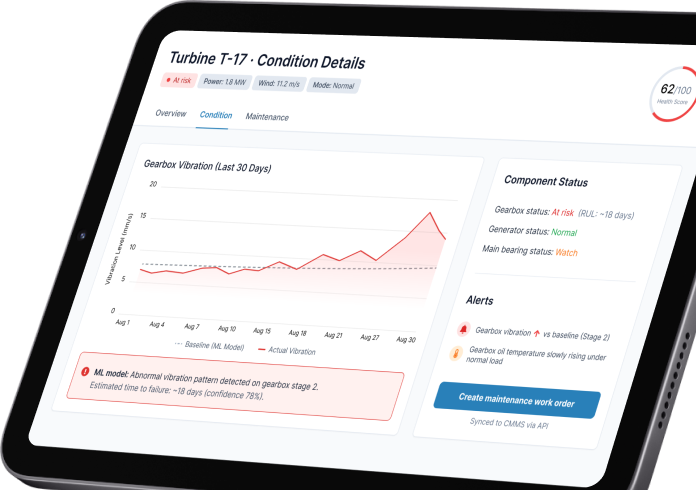
- Condition monitoring → CMMS → work orders → spare parts planning
Condition signals can create maintenance tasks with fault context, priority rules, asset history, and recommended next steps.
- Edge rules → ticketing → operator notification → audit trail
Thresholds and anomaly scores can trigger routed alerts with deduplication, escalation logic, and traceability.
Optimize your operations
Connect your legacy assets to a modern dashboard and start reducing downtime immediately.
The brownfield-to-AI pipeline
1. Legacy extraction
We collect signals from PLCs, SCADA historians, HMIs, gateways, sensors, and machine controllers through the safest available route. Depending on the site, this may use read-only connectors, protocol adapters, passive listening, or sensor overlays.
2. Semantic normalization
We map cryptic tags and registers into a plant data model. For example, a raw register can become a named asset signal with unit, location, equipment class, and maintenance context.
3. Edge filtering
We clean, compress, buffer, and route high-frequency telemetry at the edge. This keeps the legacy core from carrying data volume it was never built to handle.
4. Time-series vectorization
We feed time-series databases, data warehouses, RAG layers, and agentic workflows with governed data. The result is not another static dashboard. The goal is a pipeline that supports prediction, triage, work-order creation, and supervised intervention.

Zero-downtime integration roadmap
Industrial modernization fails when it treats the plant like a standard software environment. We structure the rollout around production safety, acceptance criteria, and rollback paths.
We inventory machines, protocols, network zones, data owners, and control constraints. The goal is to understand what can be read, what must stay isolated, and what cannot change.
We install edge gateways or sensor overlays in listen-only mode where the site allows it. The AI pipeline analyzes live telemetry in the background, while existing control logic continues to run the line.
After the pilot passes data quality, latency, security, and model-performance criteria, we enable selected workflows. These may include alerts, work-order drafts, anomaly scoring, and supervised recommendations.
We turn the validated setup into repeatable templates for other lines, sites, or asset classes. Monitoring, release control, documentation, and handover are part of the operating model.
What changes when the IoT integration is in place

Unified telemetry across sites and vendors

Faster root-cause analysis with fewer blind spots

Automated maintenance triggers and cleaner work orders

Data you can trust for analytics and forecasting
Let’s start
If you have any questions, email us info@sumatosoft.com

Frequently asked questions
How can we extract data from legacy PLCs without changing the control logic?
We use the safest available extraction method for the site. This can include read-only connectors, passive protocol listening, vendor-approved interfaces, or non-invasive sensor overlays. We do not rewrite core PLC logic unless that is part of a separate, approved OT engineering scope.
Can we use LLMs to query legacy SCADA data?
Yes, after the data is prepared for reliable retrieval. Raw SCADA logs and historian exports are not enough for an LLM. We structure telemetry into time-series records, map tags to asset context, and connect the AI layer to governed sources through RAG or tool-based retrieval.
A plant manager could ask about fault patterns, temperature excursions, maintenance history, and asset behavior, but the answer should come from validated data sources.
How do you handle schema mismatches between legacy systems and modern ML pipelines?
We normalize data at the edge. Cryptic registers, vendor tag names, unit differences, and asset IDs are mapped into a shared ontology before the data reaches ML pipelines.
For example, a raw register can become a named signal with unit, equipment, location, and timestamp context. This gives models and analysts consistent input across machines and sites.
What happens if the factory loses internet connectivity?
The edge layer can keep local functions running. Depending on the architecture, it can continue rule checks, anomaly scoring, local alarms, and data buffering.
When the connection returns, buffered telemetry syncs to the upstream systems. The cloud layer may pause, but local monitoring need not stop.
What if the machine runs on Windows 95 or XP and has no API?
We can still extract useful signals in many cases. Options include historian access, screen-reading computer vision, sensor overlays, and operator-entry capture.
For screens and analog gauges, localized OCR or computer vision can digitize readings without modifying the old software. For machine behavior, secondary sensors can capture vibration, sound, heat, and power patterns.




