AIoT development services: edge AI on your devices, run at scale
AIoT (Artificial Intelligence of Things) puts machine learning on connected devices and gateways, so data turns into decisions where it is produced. SumatoSoft builds AIoT systems end to end on the software side: device firmware, edge AI models, data pipelines, cloud backends, dashboards and MLOps. A first pilot runs in 12 weeks.
- pilot scope: devices, data pipeline, dashboards, OTA updates
- pilot targets we design for: under 50 ms edge inference and 99.9% fleet uptime, plus a first ROI baseline.
- fits: manufacturing, logistics, healthcare, energy


AIoT development services we deliver
We connect devices, structure and stream their data, add AI where it pays, and deliver dashboards and OTA updates so the system runs safely at scale. Each service plugs into your environment through clear contracts and measurable outcomes. Already running IoT devices? We can add AI analytics to an existing IoT system.

Embedded firmware for IoT devices
We write and optimize firmware on MCUs/SoCs, wire up sensors/actuators, and tune power profiles. Custom PCB design goes through our hardware partner. Devices boot reliably, sample accurately, and speak your protocols from day one.

Edge AI design and deployment
We turn AI models into on-device intelligence (TFLite/ONNX/TensorRT), optimize for your hardware, and ship containers/runtimes that act in real time, without constant cloud calls.

Data ingestion and streaming
We build pipelines from gateways to time-series storage that handle schema, units, timestamps, deduplication and replay. Your AIoT apps get clean, current data with no manual fixes.

Cloud backends for IoT
We deliver secure, scalable services for device identity, messaging, storage, and events. Our AIoT solutions are built with IaC and autoscaling, so you can add sites and devices without rework.

AI model development integrated with IoT
We train models on your sensor data, for example to spot anomalies or forecast demand, and connect their output to alerts and workflows.

Real-time monitoring and dashboards
We ship operator views for KPIs, alerts, and guided diagnostics, plus admin consoles for fleet, users, and roles. Issues surface fast, actions are one click away.

OTA updates and remote fleet management
We enable signed and staged OTA for firmware and AI models, as well as health checks and rollback. You can configure, diagnose, and control devices securely from the web or mobile.

Custom AIoT applications
We build the mix of edge, web and mobile apps you need, such as dashboards, rules engines and apps for operators and managers, matched to your process and roles.

System integration and end-to-end testing
This service is about connecting SCADA/MES/ERP/CMMS and verifying contracts, performance, and failure modes. The full stack is tested together, not just in parts.

Security and compliance
We implement per-device identity, encrypted transport, least-privilege access, and SBOMs. Logs and controls align with common standards, so audits go smoothly.

Scalability and infrastructure support
We right-size the edge and cloud, set retention, autoscaling, and cost guards, and keep environments reproducible. As you grow, performance and costs stay predictable.

DevOps, IoTOps, and MLOps
We automate builds, deployments, device provisioning, monitoring, drift checks, and retraining, so your AIoT runs as one end-to-end system.
IoT vs AIoT: what changes
IoT collects and sends device data; AIoT also runs machine learning on the device or gateway, so decisions happen where the data is produced.
If your devices only need to connect and report, without AI on the device, our IoT software development services cover that.
| IoT | AIoT | |
|---|---|---|
Where decisions happen |
In the cloud or by an operator, after the data arrives |
On the device or gateway, where the data is produced |
Data sent to the cloud |
Raw readings, streamed or sent in batches |
Mostly events, summaries and model outputs; raw data goes up when it’s needed for retraining or audits |
Typical use |
Remote monitoring, dashboards, threshold alerts |
Anomaly detection, defect detection with computer vision, failure prediction, set-point optimization |
Let’s discuss your AIoT project!
Drop us a line and discuss your project within 1 business day with SumatoSoft AIoT experts.
AIoT use cases by industry
We use the same building blocks in every industry: connected devices, a clean data stream, models at the edge and in the cloud, and dashboards that trigger action. Here is what they do in each one.
Healthcare
Stream vitals from bedside monitors and wearables, flag early signs of deterioration with anomaly models, and route alerts with audit trails and PHI segmentation.
Retail
Combine shelf cameras and RFID with POS data to detect stockouts and planogram gaps, then send replenishment tasks to the right store team.
Manufacturing
Run anomaly, SPC and defect detection at the edge on PLC and camera data, and open CMMS work orders when vibration or temperature crosses a threshold.
Smart homes & cities
Detect incidents from CCTV and sensors, and tune traffic signal timing and street lighting by corridor.
Transportation & logistics
Predict vehicle component failures from CAN/J1939, tire, brake and cold-chain data, and recompute ETAs from live traffic.
Energy & utilities
Optimize set-points for HVAC, pumps and microgrids with forecast models, and flag leaks from pressure and flow anomalies.
Agriculture
Detect crop stress and disease from drone and camera imagery, and run zone-based irrigation that keeps working offline.
Oil & gas
Detect leaks and equipment wear early from vibration, corrosion, flow and pressure sensors, and open work orders with asset IDs and parts lists.
Construction
Flag PPE violations and proximity risks with computer vision, and track equipment use and progress against the schedule.
Your niche
Not on the list? Tell us about your process, and we’ll tell you where AIoT fits.
Recent software we developed
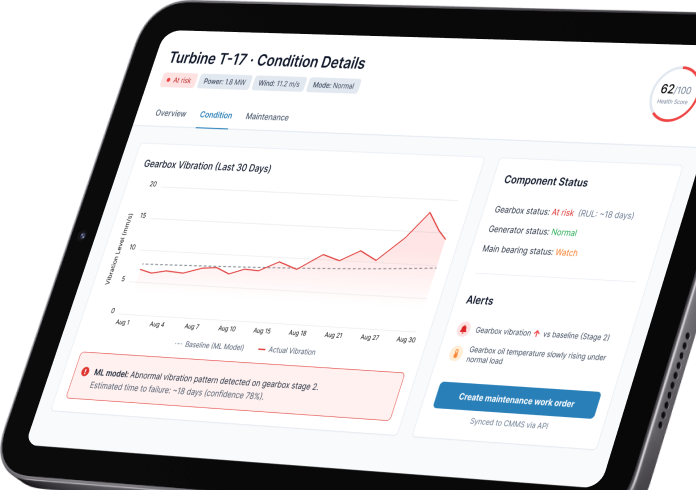


We brought in SumatoSoft to help us reduce unexpected turbine failures, and the result met our expectations. From the early stages, their team demonstrated a strong understanding of our business domain and the constraints of working with existing SCADA systems. They took a proactive approach, carefully analyzing our requirements and proposing a solution that enhanced our infrastructure without disrupting it. Communication was clear and structured, and the project was managed professionally, with all milestones delivered on time.

The system has produced a significant competitive advantage in the industry thanks to SumatoSoft’s well-thought opinions. They shouldered the burden of constantly updating a project management tool with a high level of detail and were committed to producing the best possible solution.

From the early stages of the project, SumatoSoft demonstrated a proactive attitude, actively seeking opportunities to enhance the solution and anticipate our needs. They consistently took the initiative to address any potential issues, provide timely updates, and offer solutions to challenges that arose during development. This proactiveness greatly contributed to the project’s success and exceeded our expectations.

SumatoSoft is the firm to work with if you want to keep up to high standards. The professional workflows they stick to result in exceptional quality.
Important, they help you think with the business logic of your application and they don’t blindly follow what you are saying. Which is super important. Overall, great skills, good communication, and happy with the results so far.

SumatoSoft is flexible, efficient, and extremely good at planning and being proactive. They have also been very proactive in their approach throughout the project, seeking to understand the needs and the reasons behind them before launching into development, which has been helpful for maintaining direction and consistency, especially because the end client is regularly generating new ideas for added features.

SumatoSoft succeeded in building a more manageable solution that is much easier to maintain. Their project management reflects the excellence of a larger company. Their team delivers high-quality results, attentive service, and reasonable pricing.

Industrial integrations that matter
Your AIoT only works if it plugs into the plant you already run. When providing AIoT development services, we connect to PLCs and SCADA on the shop floor, sync with MES/ERP/CMMS, and stream to historians and data lakes, using hardened connectors, clear message contracts, and time-synced, unit-normalized telemetry.
MES and shop-floor execution
ISA-95/ISA-88 aligned events (order, batch, step, state). We publish/subscribe via message contracts, so holds, quality gates, and set-point recommendations fit your process, not the other way around.
ERP and inventory
SAP, Oracle, Microsoft Dynamics. We sync materials, lots, work orders and cost centers, so ROI shows up in the system your finance team trusts.
CMMS and maintenance
IBM Maximo, SAP PM, Fiix. AI alerts create work orders with the right asset IDs and parts, completions feed back to retrain AI models and refine thresholds.
Historians and data lakes
OSIsoft/AVEVA PI, Ignition, Kafka, time-series DBs, cloud warehouses. We de-duplicate, version, and tag lineage so analytics don’t break when tags or assets change.
Building, energy, and utilities
BACnet, Modbus, AMI/SCADA energy data. We surface leak/overuse alerts and push set-point changes with audit trails to cut kWh without risking comfort or safety.
Fleet, logistics, and telematics
CAN/J1939, ELD, TMS/WMS/OMS. We correlate vehicle health, routes, and loads for fewer breakdowns and tighter ETAs.
Healthcare and regulated flows
HL7/FHIR, DICOM, GxP data controls. We keep PHI segregated, signed, and auditable while still enabling real-time monitoring and alerts.
Computer vision on the line
Cameras, PLC interlocks, and CV services integrate via low-latency topics, hold/release and reject bins are triggered deterministically.
Roadblocks we remove before we start
Some problems stall an AIoT project if nobody deals with them early. We clear these five before we write code.
We quantify ROI before we build the pilot
Problem: vague goals, moving targets, no baseline.
Fix: KPI tree and ROI model tied to a single line/site.
Deliverables: a pilot charter with success criteria, for example target cuts in downtime and scrap and a target OEE gain, agreed with you.
We integrate legacy systems with proven connectors
Problem: brittle links to SCADA/MES/ERP/CMMS.
Fix: hardened connectors and message contracts with back-pressure and retries.
Deliverables: interface specs, staging sandbox, failure-mode tests.
We make AI models deployable on target edge devices
Problem: small/noisy datasets, cloud-only AI models that won’t run on device.
Fix: data sampling plan, feature store, and edge optimizations (quantization/pruning).
Deliverables: baseline model card, on-target latency/accuracy report.
We design pipelines that tolerate bad connectivity
Problem: flaky networks, rural sites, cellular caps.
Fix: store-and-forward buffers, offline rules, differential sync.
Deliverables: connectivity playbook, SLA/SLOs for ingest and alerting.
We ship safe, staged OTA updates at scale
Problem: fear of bricking devices and model drift.
Fix: staged rollouts, health checks, instant rollback.
Deliverables: OTA runbook, canary plan, rollback tests passed.
Quick playbook: planning AIoT development project [pdf]
Free playbook: plan your AIoT pilot (PDF). Use it to scope the project and choose the right AIoT development partner. No email required.
What you get in the first 12 weeks
We ship new deliverables every week or two. Each one has an owner, acceptance criteria and a demo, so you can see progress against the plan.
Full rollouts depend on device count, edge hardware and model complexity. If you first want to check that a model works on your existing sensor data, start with a 4-week AI proof of concept.
- Pilot charter: line/site, KPIs, success thresholds, ROI model.
- Device & data audit: device matrix, protocol map, data contracts, 7-day replay TSDB.
- Security baseline: identities, access model, SBOM, key rotation plan
- Architecture draft: edge/cloud/hybrid reference, OTA path, integration points (SCADA/MES/ERP/CMMS).
- Go/No-Go kit with risks, mitigations, and timeline.
- Connectivity in place: adapters for MQTT/OPC UA/Modbus, store-and-forward buffers
- Clean stream: time sync, unit normalization, schema enforcement in a canonical telemetry model
- Data platform: time-series DB + warehouse landing, feature store stubbed for ML
- Runbooks: provisioning, fleet registry, connectivity playbook with SLOs
- Edge runtime: gateway containers, rules engine, signed OTA pipeline (canary + rollback).
- First ML baseline: An anomaly or vision model is trained on your data, and a model card is issued.
- On-target test: latency/accuracy/power are measured on the chosen device, and optimization (quantization/pruning) is applied.
- Safety nets: offline mode, back-pressure, and retries validated.
- Operator dashboard: live KPIs, alerts, guided diagnostics, audit trail.
- Closed loop: alert, action rules (hold/release, set-point recommendations).
- Integration tests: message contracts with SCADA/MES/ERP/CMMS verified in staging.
- Security hardening: zero-trust comms, secrets management, and least-privilege roles enforced.
- Limited rollout on one line/area with the canary cohort.
- Monitoring: ingest SLOs, inference latency, model drift, device health
- Data quality gates: completeness >99%, late/duplicate handling, lineage tracking
- Incident playbook: alert routing, on-call, change windows, rollback test passed
- Impact report: before/after deltas on downtime, yield, energy, cycle time, attribution by intervention
- TCO & payback: updated cost model, scale scenarios with right-sized edge and cloud
- Handover: admin training, runbooks, dashboards, IaC/recipes, access provisioning
- Next step: scale roadmap (sites/devices), compliance checklist, MLOps/IoTOps SLAs
Frequently asked questions
What is an AIoT system?
An AIoT system is a network of connected devices that also runs AI models, on the device, on a gateway or in the cloud, so it can analyze sensor data and act on it in real time. The section “IoT vs AIoT: what changes” above shows how it differs from plain IoT.
What is the difference between IoT and AIoT?
IoT connects devices and sends their data to the cloud; AIoT also runs machine learning on the device or gateway, so decisions happen where the data is produced. The table in “IoT vs AIoT: what changes” compares where decisions happen, what data goes to the cloud and typical uses.
Do you design the device hardware or only the firmware and software?
We write firmware for your chosen MCUs and SoCs and build everything from the device to the cloud: connectivity, edge AI models, data pipelines, cloud backends and apps. Custom PCB design goes through our hardware partner.
Which edge hardware can run your models (for example NVIDIA Jetson or ARM gateways)?
We deploy to the hardware you choose, from MCUs and SoCs to ARM-based gateways and GPU modules such as NVIDIA Jetson. We convert models to TensorFlow Lite, ONNX or TensorRT, shrink them with quantization and pruning, and measure latency, accuracy and power on the target device before rollout.
How do you keep models accurate after deployment?
With MLOps. We monitor each model’s accuracy, drift, latency and resource use on live data. When data or conditions change, a retraining pipeline runs, a person approves the new version, and it ships as a signed, staged OTA update that can be rolled back.
How much would your AIoT pilot cost?
Get a cost range for your project in 1 business day. Tell us how many devices and sites you have, and what the system should detect or decide.
What results do AIoT projects deliver?
In three published SumatoSoft projects, AI on top of sensor data cut downtime by 38% to 50%, and on the HVAC project it paid back in 12 months.
Fewer stoppages, higher uptime
Better quality, less scrap
Predictive maintenance that pays back
Energy and consumables under control
Real-time decisions at the edge
Safer operations, cleaner compliance
Faster throughput, shorter lead times
Clear ROI, not just dashboards
AIoT tech stack: from device firmware to cloud
From device firmware to cloud analytics, we build AIoT systems that run in the field. We write firmware for your chosen MCUs and SoCs; custom PCB design goes through our hardware partner.
Connectivity & field protocols
- MQTT, OPC UA, Modbus/TCP, CAN, BLE, Wi-Fi, LTE/5G, LoRaWAN;
- gateway containers, rules engines, store-and-forward buffers;
- per-device identity, cert provisioning, encrypted transport.
Data pipelines & storage
- time-series ingest with schema/units normalization;
- TSDB + data lake/warehouse, feature stores for ML;
- data contracts, lineage, retention, and replay for testing.
Machine learning & edge inference
- anomaly detection, forecasting, CV (defect detection, tracking);
- model cards, on-target latency/accuracy/power validation;
- retraining pipelines, A/B and canary deployment for AI models.
Applications & UX
- operator dashboards (KPIs, alerts, guided diagnostics);
- admin consoles (fleet, users, roles, audit trails);
- role-based access, internationalization, offline modes.
Ops: IoTOps + MLOps
- fleet registry, health telemetry, OTA firmware/model updates;
- monitoring for ingest, inference, drift, incident runbooks;
- IaC for repeatable environments, change windows and rollbacks.
Industrial integration
- SCADA/MES/ERP/CMMS connectors with back-pressure and retries;
- message contracts (commands, events) and staging sandboxes;
- batch and event-driven flows to existing systems.
IoT cloud platforms
- AWS IoT Core
- AWS IoT Device Defender
- AWS IoT Device Management
- AWS IoT Events
- Azure Data Lake
- Azure Digital Twins
- Azure IoT Central
- Azure IoT Hub
- Azure Kinect
- Google Cloud Datastore
- ThingSpeak
AI and ML frameworks
- Amazon S3
- Azure Blob Storage
- Databricks
- PyTorch
- TensorFlow
- XGBoost
- LightGBM
- ResNet
- YOLO
- GPT-4
- Anthropic Claude
- Llama
- Amazon SageMaker
- MLlib
Security by design for AIoT
Security isn’t a bolt-on; it’s built into every layer of our AIoT systems: gateways, devices, firmware, OTA updates and data flows. We use several methods to secure AIoT systems.
Per-device identity and zero-trust comms
Every device gets its own certificate, all links use mutual TLS, networks are segmented and deny-by-default.
Threats this measure handles: credential sharing, device impersonation, lateral movement, and man-in-the-middle.
Secure and measured boot
Firmware integrity is verified at startup (TPM/TEE, where available), storage is encrypted, and debug ports are locked.
Threats this measure handles: bootloader tampering, firmware backdoors, and data theft from stolen devices.
Signed, staged OTA
Firmware and model updates are signed, canaried, health-checked, and rolled back on failure.
Threats this measure handles: malicious updates, supply-chain injection, fleet-wide bricking.
Data minimization at the edge
Sensitive fields are filtered/anonymized/aggregated before leaving the site, and data is encrypted in transit and at rest.
Threats this measure handles: privacy leaks, excessive data exposure, interception during transport.
Least-privilege access
Fine-grained roles for users, services, and devices, keys and secrets are vaulted and rotated.
Threats this measure handles: privilege escalation, stale/compromised credentials, insider misuse.
Compliance-ready controls
Data classification, retention and access logging aligned with ISO/IEC 27001, SOC 2 and GDPR requirements.
Threats this measure handles: regulatory non-compliance, over-retention of PII, unauthorized access.
We keep your AIoT smart: MLOps and IoTOps built-in
MLOps and IoTOps are how your AIoT system keeps working after launch. MLOps manages the brains: it gets AI models from the lab into production, watches their accuracy in the real world, and updates them safely when data or conditions change. IoTOps manages the machines: it onboards devices in bulk, tracks their health, pushes safe over-the-air updates, and keeps data flowing even with spotty networks. Together, they cut downtime, prevent silent errors, and let you scale from one site to many without surprises.
MLOps – AI model operations
- version everything: datasets, features, AI models, and inference images have IDs and lineage;
- one-click deploy to edge or cloud serving, canary and A/B supported;
- live monitoring of accuracy, drift, latency, and resource use tied to each model version;
- automated retraining pipelines on new data or drift triggers, human approval before promotion;
- model cards with on-device validation (latency, power, accuracy) and rollback snapshots;
- full governance: access controls, audit trails, reproducible builds and signed artifacts.
IoTOps – device & fleet operations
- fleet registry with per-device identity, health, config, and ownership;
- provisioning at scale: golden images, bootstrap scripts, and secure enrollment;
- signed OTA for firmware and AI models with staged rollouts and health gates;
- telemetry you can act on: ingest SLOs, device vitals, link quality, error budgets;
- resilience patterns: store-and-forward, back-pressure, offline rules, safe modes;
- incident playbooks: alert routing, change windows, rollback steps, post-incident notes.
Why SumatoSoft is the right AIoT development company
Since 2012, we’ve helped companies turn new IT ideas into a competitive advantage, IoT and now AIoT included. Over the years, we’ve built, integrated, and scaled connected systems end to end: from device firmware and secure connectivity to data pipelines, ML models, and the apps and ops that run them. Along the way, we distilled clear, non-negotiable practices for reliable AIoT delivery that we apply when providing our services. Today, we’re a trusted software partner for businesses in 25+ countries, including the US.

End-to-end expertise

Security mastery

Transparency & ongoing support

Edge performance proven on your devices
For 14+ years, we have proudly taken responsibility for your projects!
Awards & Recognitions


Let’s start
If you have any questions, email us info@sumatosoft.com


