Machine Learning (ML) Development & Consulting Services
Custom models, MLOps pipelines, and production deployment, engineered as one system. Most ML pilots stall before they reach production. The model works in testing, and then nobody connects it to the live databases, APIs, and processes it was built to run inside. SumatoSoft builds the model and the engineering around it, so your ML reaches production, keeps learning, and stays under your control.
What machine learning capabilities does SumatoSoft cover?
The services we offer across the ML lifecycle.

Data & pipeline engineering
ETL and ELT workflows, real-time streaming, and feature pipelines that feed clean, consistent data into your models.

Multi-modal model engineering & edge AI
Models that combine sensor, video, and structured inputs, tuned with quantization and hardware-aware optimization to run in real time, including on edge devices.

MLOps & continuous learning pipelines
Automated pipelines with model monitoring, drift detection, version control, and controlled retraining.

System integration & operational embedding
Connecting models to your infrastructure through APIs and event-driven architecture, so predictions run inside the processes you already operate.
Transform Your Business with ML
Go beyond off-the-shelf solutions. We build custom machine learning models that solve your unique challenges and drive real results.
Which industries do SumatoSoft’s ML services support?
We focus on sectors where the data is complex and a wrong prediction has a real cost.
Finance & fintech
Transaction analysis, risk scoring, and anomaly detection that run inside decision flows in real time, with traceable outputs your compliance team can audit.

Healthcare & life sciences
Models that work with clinical, operational, and patient data to support diagnostics, planning, and resource allocation, inside governed environments built around data privacy.

Logistics & supply chain
Demand, routing, and inventory models that react to live conditions and feed decisions straight into your logistics operations.

Manufacturing & industrial
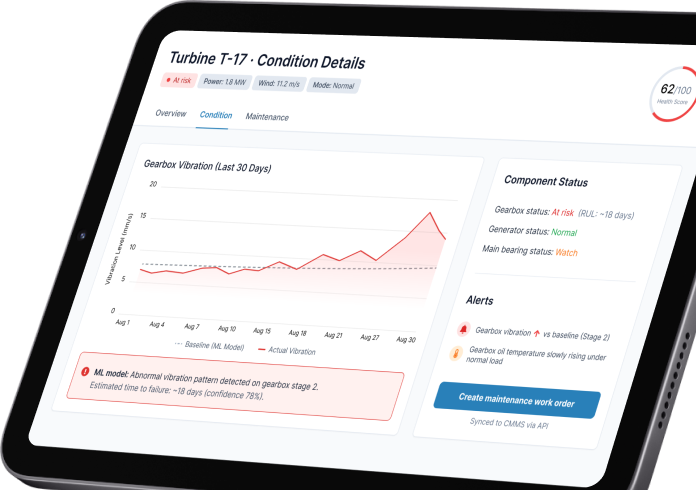
Models that read equipment signals (vibration, temperature, acoustic, process data) to catch deviations and trigger maintenance or quality checks on the line, combining edge processing with central analytics.

How can you engage SumatoSoft for ML development?
Three ways to start, depending on how far along you are.

ML architecture audit
We assess your data, infrastructure, and integration points, then hand back defined use cases, an architecture blueprint, and a prioritized roadmap. Start here when you need a clear foundation before anyone writes code.

System architecture design
We design the full system before development begins: data flow, model placement, MLOps configuration, and the points where it connects to your existing systems. You get a build-ready blueprint with defined components and owners.

Production system delivery
We build and deploy the system into your environment: data pipelines, models, APIs, CI/CD, monitoring, and validation, delivered ready to run.
How does SumatoSoft build ML for continuous learning (ADLC)?
We treat machine learning as something that runs and improves over time, not a model handed over once and forgotten. Our agentic development lifecycle (ADLC) links every stage, so the model that goes live keeps performing as your data shifts.
In practice, the model doesn’t sit in a dashboard waiting to be checked. It scores the transaction, flags the anomaly, or reroutes the shipment inside the process that already runs it, then logs the result so the next version trains on it.

Data pipelines prepared for real use
We structure your data into pipelines that clean and transform it the same way for training and for live operation, so the model behaves in production the way it did in testing.

Model development aligned with business metrics
Models train on your operational data and get measured against the metrics you actually care about, not benchmark accuracy alone.

Validation and controlled deployment
Each model is tested against real scenarios and released through structured pipelines, so going live is predictable rather than risky.

Integration into your workflows
The model connects to your APIs, platforms, and systems, where it starts producing predictions that drive decisions or trigger actions.

Performance monitoring
Once it’s live, we track accuracy and behavior on real data, so you can see how the model holds up over time.

Retraining and version updates
As new data arrives, models retrain through controlled pipelines. Each update is tested, versioned, and deployed without interrupting what’s already running.
What does enterprise ML maturity look like?
Machine learning tends to mature in three stages. Knowing which one you’re in tells you what to fix next. We move ML systems from one level to the next.
 Level 1. Structured analytics
 Level 2. Predictive MLOps systems
 Level 3. Agentic & edge AI systems
Structured analytics
ML runs separately from your systems. Models produce predictions, but no one’s day-to-day work depends on them.
Example: a demand forecast runs weekly in a notebook and gets exported to Excel for manual planning.
Predictive MLOps systems
ML is embedded in your systems. Predictions reach workflows and get used inside your platforms.
Example: a fraud model scores transactions in real time and flags suspicious activity inside your payment system.
Agentic & edge AI systems
ML executes decisions. Systems process data in real time and act inside operations.
Example: a logistics system spots a delay, reroutes shipments, updates the ERP, and notifies stakeholders without a human in the loop.
What business impact can machine learning deliver?
Machine learning earns its place when it runs inside your operations. Here’s what SumatoSoft’s systems have delivered:
- 50% less unplanned downtime in 8 months from explainable predictive maintenance added to a manufacturer’s existing IoT platform.
- 98% on-time delivery and 22% lower last-mile cost from real-time route optimization for a freight service, with no extra trucks added.
- 38% less unplanned downtime and 97.7% availability in 12 months from a predictive-maintenance layer on a German operator’s 28-turbine wind farm.
The pattern holds across projects: models embedded in live operations, producing gains you can measure on the bottom line.

What is SumatoSoft’s ML technology stack?
We pick tools based on the task, your data, and what your infrastructure supports. Here’s what we work with.
Machine learning algorithms
We use supervised models (logistic regression, decision trees, XGBoost, SVMs) for classification, scoring, and forecasting; unsupervised models for clustering and anomaly detection; time-series models (ARIMA, Prophet, ML ensembles) for demand and risk forecasting; and hybrid pipelines that mix rules and ML to handle edge cases. We choose models on empirical benchmarks and validate them against your KPIs.
Deep learning
When the data is unstructured or the problem is too complex for classical ML, we build and train neural networks: CNNs for visual input, RNNs and Transformers for sequence and language tasks, autoencoders for noise reduction and anomaly detection, and custom architectures for multi-modal inputs. We support distributed training, GPU and TPU acceleration, and model versioning.
AutoML
We use AutoML tools (Vertex AI, SageMaker Autopilot, H2O.ai, MLJAR) to reach a first model faster in prototyping. We audit every generated model and benchmark it against custom-built alternatives, so it stays a starting point rather than a black box.
Big data processing
For high-volume data we build distributed pipelines on Spark, Hadoop, and Airflow; real-time streaming with Kafka and Flink; and ETL and ELT pipelines that handle terabytes a day for training and inference.
| Services | Tools samples |
|---|---|
ML & AI frameworks/libraries |
TensorFlow, PyTorch, Scikit-learn, Keras, XGBoost, LightGBM, OpenCV, Hugging Face Transformers, spaCy, NLTK, FastText, LangChain, MLlib (Apache Spark). |
Programming languages |
Python, R, Java, C++, JavaScript / TypeScript (for frontend/backend integration), Go, Scala. |
Data & pipeline tools |
Apache Airflow, Apache Kafka, Apache Spark, Pandas, NumPy, Dask, dbt (for data transformation). |
Cloud platforms & infrastructure |
AWS (SageMaker, EC2, S3, Lambda), Microsoft Azure (Machine Learning, Blob Storage), Google Cloud Platform (Vertex AI, BigQuery, AutoML), IBM Cloud, DigitalOcean (for small-scale deployments), Snowflake. |
DevOps & MLOps |
Docker, Kubernetes, MLflow, DVC, Kubeflow, Jenkins, GitHub Actions, Terraform, Prometheus + Grafana (for monitoring). |
Databases & storages |
PostgreSQL, MySQL, MongoDB, Cassandra, Redis, ElasticSearch, Amazon Redshift, BigQuery, MinIO (S3-compatible object storage). |
Visualization & dashboarding |
Power BI, Tableau, Looker, Grafana, Streamlit, Dash by Plotly, Superset. |
What ML projects has SumatoSoft delivered?



The system has produced a significant competitive advantage in the industry thanks to SumatoSoft’s well-thought opinions.
They shouldered the burden of constantly updating a project management tool with a high level of detail and were committed to producing the best possible solution.

I was impressed by SumatoSoft’s prices, especially for the project I wanted to do and in comparison to the quotes I received from a lot of other companies.
Also, their communication skills were great; it never felt like a long-distance project. It felt like SumatoSoft was working next door because their project manager was always keeping me updated. Initially.

We tried another company that one of our partners had used but they didn’t work out. I feel that SumatoSoft does a better investigation of what we’re asking for. They tell us how they plan to do a task and ask if that works for us. We chose them because their method worked with us.

SumatoSoft is the firm to work with if you want to keep up to high standards. The professional workflows they stick to result in exceptional quality.
Important, they help you think with the business logic of your application and they don’t blindly follow what you are saying. Which is super important. Overall, great skills, good communication, and happy with the results so far.

They are very sharp and have a high-quality team. I expect quality from people, and they have the kind of team I can work with. They were upfront about everything that needed to be done.
I appreciated that the cost of the project turned out to be smaller than what we expected because they made some very good suggestions. They are very pleasant to work with.

Rivalfox had the pleasure to work with SumatoSoft in building out core portions of our product, and the results really couldn’t have been better.
SumatoSoft provided us with engineering expertise, enthusiasm and great people that were focused on creating quality features quickly.

SumatoSoft succeeded in building a more manageable solution that is much easier to maintain.

Thanks to SumatoSoft’s can-do attitude, amazing work ethic, and willingness to tackle clients’ problems as their own, they’ve become an integral part of our team. We’ve been truly impressed with their professionalism and performance and continue to work with the team on developing new applications.
We are completely satisfied with the results of our cooperation and will be happy to recommend SumatoSoft as a reliable and competent partner for development of web-based solutions

Why choose SumatoSoft for ML development?

From notebook to production.
Data scientists build models. Software engineers build applications. We do both. Most failed pilots break at the seam between them, when Python scripts never get connected to the legacy SQL databases or live API limits they have to work with. Our team builds that connection and the CI/CD pipelines that put the model into real use.

MLOps that keeps models honest.
Models lose accuracy the moment they meet live data. We build automated pipelines with telemetry (MLflow, Weights & Biases) that watch for data drift. When accuracy drops below your threshold, the pipeline pulls the new data and triggers a retraining cycle, so the model gets sharper over time instead of quietly decaying.

Governance built into the architecture.
We engineer explainability into the model from the start, using SHAP and LIME so every decision can be traced and explained to a regulator. That matters in finance, healthcare, and logistics, where an unexplained “shadow” model is a liability.

No Vendor Lock-In
We build on containerized, open-source standards (Kubeflow, Docker, MLflow). Run inference on SageMaker, Azure, or your own on-premise hardware. You own the IP and control the infrastructure.
Awards & Recognitions



Frequently asked questions
How much does machine learning development cost?
Machine learning costs depend on three things: how ready your data is, how complex the model is, and how deeply the system integrates with your operations. As a general guide, a focused feasibility study or ML architecture audit typically starts in the low five figures, while a full custom model — built, validated, and deployed into production — usually ranges from roughly $50,000 to $250,000+, depending on scope and the number of models. The biggest cost driver is rarely the model itself; it’s data preparation.
How long does it take to build a machine learning model?
A straightforward model with clean, available data can move from kickoff to production in roughly 6–10 weeks. A more complex system — computer vision, custom data collection and labeling, edge deployment, or deep enterprise integration — typically takes three to six months. Across most engagements, model training is rarely the bottleneck; data preparation, feature engineering, and integration account for the majority of the timeline.
When should a business hire an ML development company?
Bring in an external ML partner when the problem is real, the data exists, and your internal team can’t close the gap alone — or when a pilot has stalled. The classic signals: a proof of concept that won’t reach production, a model whose accuracy has plateaued, or a previous vendor who left you an undocumented model with no retraining pipeline. What rarely pays off is hiring before you’ve confirmed ML is the right tool at all — which is why our first conversation is always about whether ML, a rules engine, or a simpler approach fits best.
Should we build ML in-house or outsource it?
Build in-house if you have a mature data-science team, clean and accessible data, and ML models that are core to your product’s differentiation. Outsource if you’re running your first ML project, your team is strong on research but thin on production engineering, or you need to move faster than internal hiring allows. SumatoSoft’s dual-engine team exists for exactly that gap — data scientists who build the model and software engineers who operationalize it — so your ML doesn’t stall between the lab and your live systems. Many enterprises engage us for the initial build while growing internal MLOps capability in parallel.
What’s the difference between ML and AI development?
Machine learning is a subset of AI, so all ML development is AI development — but not the reverse. The distinction that matters for buyers is between classical ML and generative AI. Classical ML — fraud detection, predictive maintenance, demand forecasting, image classification — trains on your structured or labeled data, and is deterministic, auditable, and cost-efficient. Generative AI produces new content and runs on large foundation models. The common 2026 mistake is defaulting to Gen AI for problems a well-trained classification or regression model would solve more reliably and far more cheaply.
Let’s start
If you have any questions, email us info@sumatosoft.com