IoT software development services: devices, edge and cloud in one system
SumatoSoft is an IoT software development company. We build the software side of connected products: device integration and firmware updates, edge processing, cloud backends, dashboards and predictive ML. Since 2012 we have delivered 350+ projects under ISO 27001, and we usually show a working MVP within 6 months, with demos every two weeks.


Our IoT software development services
We design IoT systems that collect device data, process it, and turn it into action across distributed environments. We handle the full scope. That means device integration, edge architecture, predictive models, secure operations, and the apps your people actually use.

Data acquisition and device integration
We build the software layer that connects your sensors, industrial equipment, wearables, cameras, gateways, and embedded devices into one controlled system. That layer handles ingestion, protocols, secure transfer, and the communication between each device and the platform. We write device firmware and the device-to-cloud software; custom boards and PCB design are delivered with our hardware partner.

Real-time ETL and edge computing
High-frequency telemetry should not flood the cloud unchecked. We design edge pipelines that filter, normalize, compress, and process data where it is generated. Only the events that matter move upstream, together with state changes, aggregated summaries, and system signals. That cuts cloud traffic, storage load, and latency.

Predictive ML and agentic automation
Dashboards show what already happened. AI helps decide what should happen next. We deploy machine learning models for anomaly detection, predictive maintenance, demand forecasting, and system optimization. Those models connect to your business rules, operator workflows, automated actions, and control logic.

IoT dashboards, control apps, and operator interfaces
We build web and mobile apps for monitoring and control, alert handling, and fleet visibility, with permissions set by role. Where it fits the use case, we add a natural-language interface on top of live telemetry and historical data, so an operator can simply ask.

Security audit and device trust architecture
We review the security of your whole IoT ecosystem, including devices, gateways, APIs, cloud services, and update pipelines. That review covers device identity and certificate-based authentication, encrypted transport, access control, auditability, and secure firmware delivery.

OTA updates and fleet operations
We build fleet-management tooling that provisions devices and updates them remotely, with rollout control, diagnostics, version tracking, and rollback when an update goes wrong. That keeps large deployments maintainable without constant hands-on work.
IoT services by need

IoT consulting services
Architecture review, an AI-readiness check and a pilot plan before you commit to a build.

Enterprise IoT solutions
Multi-site IoT platforms for distributed assets and high data volumes, connected to your ERP.

IoT solutions for manufacturing
Industrial IoT (IIoT) for production lines: machine monitoring and predictive maintenance.

IT/OT convergence and brownfield integration
Connect legacy machines and existing software to a modern IoT stack through gateways and protocol translation.

IoT security and compliance services
Device identity, encrypted transport, secure firmware delivery and compliance reviews.

IoT for small and mid-sized businesses
Focused pilots and right-sized IoT software for smaller teams and budgets.

AIoT development services
Machine learning at the edge and in the cloud: anomaly detection, predictive models and copilots on telemetry.

IoT data analytics
Pipelines, dashboards and analytics that turn sensor data into decisions.

Predictive maintenance software
Models that flag equipment failures early, built on your sensor and maintenance data.
Off-the-shelf IoT platform or custom IoT software?
An off-the-shelf platform is faster to start. Custom software fits when you need your own device protocols, full data ownership or no per-device fees. We also build on top of platforms such as AWS IoT Core and Azure IoT Hub when that is the faster path. Not sure which fits your case? Our IoT consulting services compare both for your devices, fleet size and budget.
| Parameter | Off-the-shelf IoT platform | Custom IoT software |
|---|---|---|
Time to first dashboard |
Faster: standard devices connect through configuration |
Longer: starts with discovery and architecture |
Device and protocol support |
The devices and protocols the platform supports |
Any device or protocol, including legacy and proprietary ones |
Per-device and usage fees |
Licence or per-device fees grow with the fleet |
No per-device licence; you pay for the build and your own cloud |
Data ownership |
Data sits in the vendor’s environment and formats |
Data stays in your cloud or on-premise, in your formats |
Workflows and integrations |
Configurable within the platform’s options |
Built around your workflows, ERP and operator apps |
Best fit |
Pilots, standard sensors, small fleets |
Products you sell, large or mixed fleets, strict compliance |
Let’s discuss your IoT project!
Drop us a line and discuss your project within 1 business day with SumatoSoft IoT experts.
IoT solutions for asset-heavy industries
Hardware, protocols, and operating constraints differ by industry, but the underlying system patterns repeat far more often than the industry labels suggest. We build IoT architectures around those repeating patterns, then adapt each one to your devices, workflows, and compliance needs.
Manufacturing
We build predictive-maintenance systems that run close to your equipment and catch anomalies before a breakdown stops production. Depending on the environment, that can include thermal monitoring, vibration analysis, acoustic anomaly detection, inference on the gateway, maintenance-workflow integration, and operator alerts.
Logistics and fleet operations
We develop edge-enabled fleet platforms for vehicle tracking, route monitoring, estimated-arrival (ETA) recalculation, cold-chain supervision, and driver-event analysis. When the connection drops, the local logic keeps running and syncs again once the network is back.
Smart buildings and distributed facilities
We create IoT platforms that monitor HVAC, control energy, optimize for occupancy, run building alarms, and track equipment health across many sites. This is where AI earns its place. It cuts waste, spots equipment degrading early, and supports maintenance planning.
Brownfield industrial environments
We connect legacy machines to a modern software stack without making you replace the hardware first. That usually means gateway integration, protocol translation, secure telemetry transport, and a software layer that standardizes data from equipment of different generations.
Recent IoT software we developed




From the early stages of the project, SumatoSoft demonstrated a proactive attitude, actively seeking opportunities to enhance the solution and anticipate our needs. They consistently took the initiative to address any potential issues, provide timely updates, and offer solutions to challenges that arose during development. This proactiveness greatly contributed to the project’s success and exceeded our expectations.

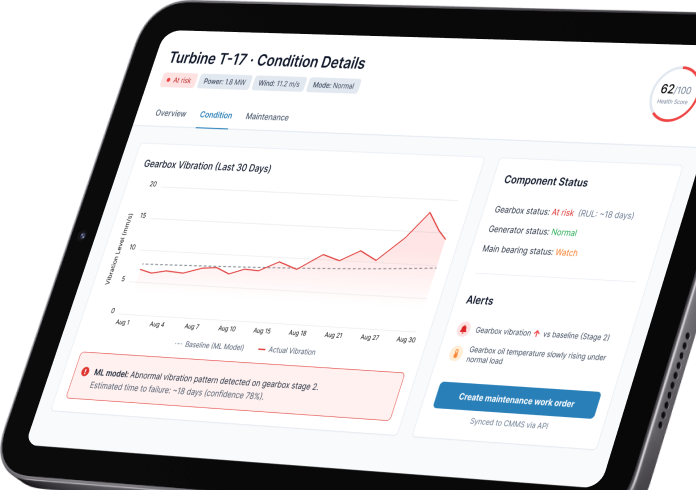
We brought in SumatoSoft to help us reduce unexpected turbine failures, and the result met our expectations. From the early stages, their team demonstrated a strong understanding of our business domain and the constraints of working with existing SCADA systems. They took a proactive approach, carefully analyzing our requirements and proposing a solution that enhanced our infrastructure without disrupting it. Communication was clear and structured, and the project was managed professionally, with all milestones delivered on time.

The system has produced a significant competitive advantage in the industry thanks to SumatoSoft’s well-thought opinions. They shouldered the burden of constantly updating a project management tool with a high level of detail and were committed to producing the best possible solution.

We tried another company that one of our partners had used but they didn’t work out. I feel that SumatoSoft does a better investigation of what we’re asking for. They tell us how they plan to do a task and ask if that works for us. We chose them because their method worked with us.

SumatoSoft is the firm to work with if you want to keep up to high standards. The professional workflows they stick to result in exceptional quality.
Important, they help you think with the business logic of your application and they don’t blindly follow what you are saying. Which is super important. Overall, great skills, good communication, and happy with the results so far.

They are very sharp and have a high-quality team. I expect quality from people, and they have the kind of team I can work with. They were upfront about everything that needed to be done.
I appreciated that the cost of the project turned out to be smaller than what we expected because they made some very good suggestions. They are very pleasant to work with.

SumatoSoft is flexible, efficient, and extremely good at planning and being proactive. They have also been very proactive in their approach throughout the project, seeking to understand the needs and the reasons behind them before launching into development, which has been helpful for maintaining direction and consistency, especially because the end client is regularly generating new ideas for added features.

Rivalfox had the pleasure to work with SumatoSoft in building out core portions of our product, and the results really couldn’t have been better.
SumatoSoft provided us with engineering expertise, enthusiasm and great people that were focused on creating quality features quickly.

SumatoSoft succeeded in building a more manageable solution that is much easier to maintain. Their project management reflects the excellence of a larger company. Their team delivers high-quality results, attentive service, and reasonable pricing.

Working with SumatoSoft has been an outstanding experience. Their team is not only highly skilled but also incredibly responsive, collaborative, and committed to delivering quality results. I can’t recommend them enough! Thank you team SumatoSoft for bringing my vision to life.

Get a free IoT app estimation
Quick playbook: selecting an IoT development partner [pdf]
Get a free playbook that will help you find the right IoT development partner. No email required.
Our IoT development process
Every IoT project starts with a detailed hardware-software integration roadmap. The tight link between hardware and software is what sets IoT work apart from standard development, since the hardware usually keeps evolving while the software is being built.
We examine and document every side of the project. That covers what you and your users need, the state of your existing software, the market and operating environment, and the costs involved. The goal is to make sure the IoT solution will meet both your business goals and your users’ needs.
Next we map out the software and hardware components, how they interact, how data flows, and how the IoT network is structured. We choose the communication protocols, the databases, and the cloud or on-premise storage, and we decide how data will be processed and analyzed. The step ends with a full system-architecture document that acts as the technical blueprint for the build.
We carefully build and test the software and the way it communicates with the smart devices on the network. We work to proven engineering practices, including version control, continuous integration and delivery (CI/CD), automated testing, regular code reviews, and secure coding standards.
How we deploy depends on your industry, the number of devices, and other factors. It might mean a phased rollout, a simultaneous launch across several locations, or a partial release to specific device versions.
Our work doesn’t stop at launch. We keep the system healthy over time by updating technologies, shipping new security patches, and monitoring both performance and the overall health of the IoT ecosystem.
How much does IoT software development cost?
Most projects we deliver fall in a $100,000–500,000+ band. A focused pilot for a small or mid-sized business usually lands in the $30k–$80k range for software and delivery, with hardware budget added on top if new sensors or gateways are needed. We usually show a working MVP within 6 months.
| Project type | Indicative range | Typical timeline | What’s included |
|---|---|---|---|
Focused pilot (one line, site or device group) |
$30k–$80k for software and delivery; hardware extra |
8–12 weeks once site access, hardware and source-system details are in place |
Device connection, data pipeline, a dashboard and agreed success metrics |
IoT MVP or first product release |
Within the $75,000–250,000+ band |
Within 6 months, with a demo every two weeks |
Device integration, cloud backend, web or mobile app, OTA updates |
Multi-site or enterprise rollout |
Within the $100,000–500,000+ band |
Within 6-12 months, with a demo every two weeks |
Fleet management, ERP and CRM integration, security review, support |
Takeover of an existing IoT product |
From $25,000 |
Starts with a code and architecture audit. Length – from 4 weeks. |
Audit, stabilization, then new features |
What moves the cost most:
See the full breakdown in our IoT development cost guide. |
Get a cost range for your project in 1 business day.
Technologies we work with


| Type | Technologies Used |
|---|---|
Cloud IoT platforms |
AWS IoT Core, AWS IoT Device Management, AWS IoT Device Defender, AWS IoT Events, Azure IoT Hub, Azure IoT Central, Azure Digital Twins, ThingSpeak |
Data and machine learning |
Azure Data Lake, Google Cloud Datastore, Apache Spark MLlib, time-series databases |
Industrial protocols and connectivity |
OPC UA, Modbus, Bluetooth Low Energy (BLE), MQTT, CoAP, LoRaWAN |
Edge ML runtimes |
TensorFlow Lite, ONNX, TensorRT |
Devices and sensing |
Azure Kinect |
IoT architecture: from sensors to ERP
We design every layer of the IoT architecture, from sensors and connectivity protocols to edge devices and cloud platforms. We pick the technology stack that fits your industry, connect the network to business tools like your CRM and ERP, and shape the whole IoT ecosystem around your requirements, device capabilities, compatibility needs, budget, and timelines.

From raw telemetry to controlled IoT systems
We design IoT architectures that filter data at the edge, let models interpret it, and connect the results to system actions and operator workflows.

Controlled data flow
Edge pipelines filter out noise, detect anomalies, and send only meaningful events, state changes, and aggregated signals. The result is lower cloud load, faster response, and predictable cost.

Hardware-agnostic architecture
We keep business logic and AI workflows separate from the device-specific layers, so you can swap sensors, gateways, or legacy machines without breaking the platform. The result is no lock-in, easier scaling, and safer upgrades.

Simulation before deployment
We build digital twins that combine live telemetry with past system behavior, so your teams can model load, maintenance timing, and operational scenarios before they happen. The result is fewer incidents, better planning, and lower risk.
Why enterprises trust SumatoSoft for IoT delivery
Since 2012 we have helped companies gain an edge with current technology, IoT included. Over those years we have built deep experience in IoT and distilled it into a clear set of requirements every IoT build should meet. Today we are a trusted development partner for businesses in 25+ countries, including the US.

Fail-safe OTA guarantee

Security and compliance

Quick time to market

Scalability

Transparency

IoT device management
SumatoSoft IoT delivery in numbers
Awards & Recognitions


Frequently asked questions
How much does custom IoT software development cost?
Most projects we deliver fall in a $100,000–500,000+ band. A focused pilot for a small or mid-sized business usually lands in the $30k–$80k range for software and delivery, with hardware budget added on top if new sensors or gateways are needed. The main cost drivers are fleet size, protocols, edge machine learning and compliance. Our IoT development cost guide breaks this down further.
How long does it take to build an IoT MVP?
We aim for a working MVP within 6 months and show new functionality in a demo every two weeks. A focused pilot on one line, site or device group typically takes 8–12 weeks when site access, hardware and source-system details are in place. Larger rollouts follow in phases once the pilot has proved its numbers.
Do you design IoT hardware, or only the software and firmware?
We write device firmware and all the software from device to cloud: edge processing, backends, dashboards and mobile apps. Custom boards and PCB design are delivered with our hardware partner. We also integrate off-the-shelf sensors and gateways, and the legacy equipment you already run.
Which IoT platforms do you build on, such as AWS IoT Core or Azure IoT Hub?
We build on AWS IoT (Core, Device Management, Device Defender and Events), Azure IoT Hub, Azure IoT Central and Azure Digital Twins, and we also build fully custom backends. The choice depends on the cloud you already use, your fleet size, your device protocols and per-device costs. We compare the options with you before you commit.
Can you take over an existing IoT product built by another vendor?
Yes. We start with a code and architecture audit (from 4 weeks), then stabilize the system and take over support and new features. Existing devices and legacy equipment can stay: we connect them through gateways and protocol-translation layers instead of replacing them first.
More about our IoT development services
Let’s start
If you have any questions, email us info@sumatosoft.com


