Case study: IoT platform for non-revenue water reduction at a municipal utility
A municipal water utility in Portugal supplies 450,000 connections through 6,200 km of mains. 28% of the water it produced never reached a bill, and crews conducted a five-year manual survey cycle that took 21 days to pinpoint a single burst. The Client engaged SumatoSoft to build a platform that zones the network and flags developing bursts. Within 18 months, non-revenue water fell from 28% to 19.5%, recovering 5.4 million cubic meters a year. Burst localization was reduced to 3 days, and the program returned €3.9M annually on a €5.28M investment.
Project details:
About the Client:
The Client is a municipal water utility in Portugal supplying 1.15 million people through 450,000 connections and 6,200 km of distribution mains.
Location: Portugal
Industry:Water utilities and municipal services
Team size:9 specialists (1 system architect/team lead, 1 business analyst, 3 backend developers, 1 frontend developer, 1 data engineer, 1 ML engineer, 1 QA engineer)
Project duration: 18+ months
Business challenge:
The Client needed to cut water losses without raising tariffs or rebuilding the network. Non-revenue water accounted for 28% of system input, worth €8.78M per year. The network had never been zoned, so a leak could only be found by walking the supply area, and contractors covered 1,240 km a year on a five-year cycle. Meanwhile, 31% of the meter fleet was under-registering, and the utility had no way to identify which meters were the problem.
Additional requirements:
- Work with the existing SCADA and telemetry
- Zone the network without interrupting the supply to any district
- Target meter replacement by measured under-registration
- Produce regulator-ready water balance reporting from the same data
Our solution
SumatoSoft built a loss management platform that treats the network as 84 districts, with boundaries modeled in PostGIS. An ingestion layer on AWS IoT Core takes district meter flow, zone pressure, acoustic logger signatures over LoRaWAN, and smart meter reads over NB-IoT. A nightly water balance runs per district, comparing minimum night flow with modeled legitimate use. Gradient-boosted models learn each district’s flow signature and flag a burst a median of 4 days before the first customer report. Confirmed alerts pass to the work order system with a leak position from the nearest logger pair.
District metering and pressure control
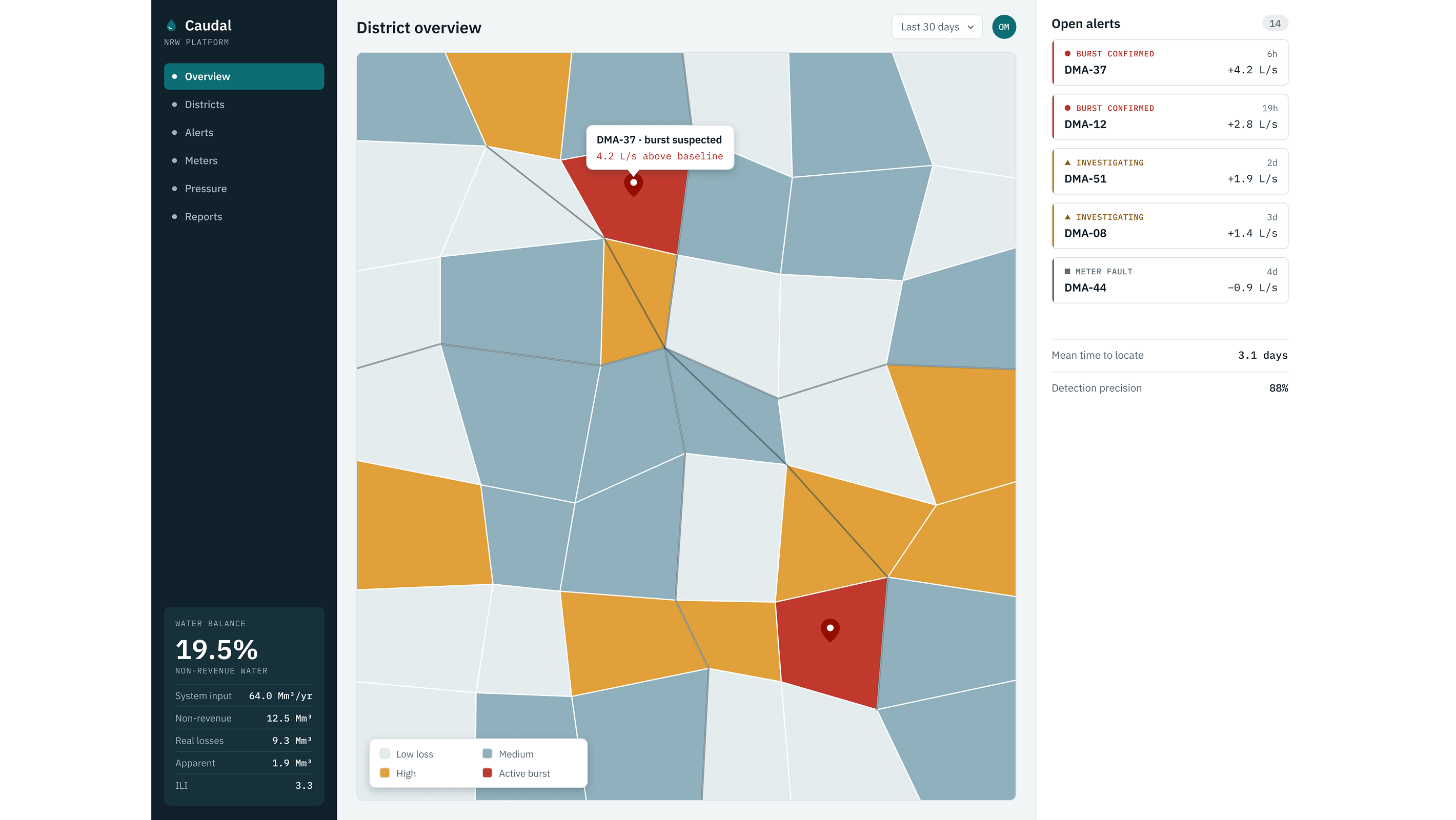
Operators can see every district on a single map: night flow trend, loss band, open alerts, and days since the last survey. Meter scoring retargeted replacement from 140,000 units by age to 24,000 by measured error, recovering a million cubic meters of apparent loss. Pressure modulation across 26 districts maintained minimum service pressure and reduced mains breaks from 24 to 17 per 100 km, eliminating 434 repairs per year.

Additional features:
- Nightly per-district water balance with minimum night flow analysis
- ML burst detection with acoustic correlation for leak positioning
- Meter under-registration scoring across the 450,000-meter fleet
- Pressure modulation control with minimum service pressure guarantees
- IWA-standard water balance and Infrastructure Leakage Index reporting for the regulator

Business value
Before:
- Non-revenue water accounted for 28% of system input, totaling 17.9 million cubic meters per year, worth €8.78M.
- Leak detection depended on a five-year manual survey cycle covering 1,240 km a year, and locating a burst took 21 days.
- Real losses ran at 83 liters per connection per day, with an Infrastructure Leakage Index of 4.8.
- Meter replacement followed installation age, so accurate meters were replaced while under-registering ones stayed in service.
- Pressure ran at fixed setpoints, and mains failed at 24 breaks per 100 km per year.
After:
- Non-revenue water fell to 19.5%, recovering 5.4 million cubic meters a year and returning €3.9M annually.
- All 6,200 km are under continuous acoustic monitoring, and burst localization takes 3 days.
- Real losses fell to 57 liters per connection per day, with the Infrastructure Leakage Index down to 3.3.
- Under-registration scoring targeted 24,000 meters for replacement instead of 140,000, recovering 1 million cubic meters of apparent loss.
- Pressure modulation across 26 districts cut breaks to 17 per 100 km per year, removing 434 repairs from the annual workload. The €5.28M program was paid back in month 25.