Your Line Already Produces the Data. Getting It Out Is the Project.
SumatoSoft handles custom manufacturing software development for plants across the US and EU, including production monitoring and OEE, MES and shop-floor execution, and quality and traceability. Each system reads from the controllers, sensors, and ERP you already run. Every engagement begins with a paid assessment that maps your floor, machine by machine, so you know what the data can support before anyone quotes a build.







Manufacturing software we build: monitoring, MES, quality, traceability
Every engagement starts from your floor. These are the systems manufacturers ask us for most often.

Production monitoring and OEE
Live machine state, downtime reasons, and output by line, read from PLCs and sensors, or from operator entry where the signal does not exist.
MES and shop-floor execution
Work orders, routings, operator instructions, and lot genealogy, sequenced the way your plant sequences work. That includes the exceptions your current system makes people route around.
Traceability and quality
Component-to-lot genealogy, inspection capture, defect tracking, SPC, and audit-ready records. Built to whichever standard governs you, whether IATF 16949, IPC-1782, ISO 9001, or a customer’s own supplier requirements.
Equipment health and maintenance
Preventive schedules, work-order flow, spare-parts visibility, and condition monitoring wherever the signal carries it. Where the signal cannot carry a model, we say so instead of fitting one anyway.
Inventory and material flow
Stock accuracy, WIP visibility, material movement and consumption against plan, tied to production closely enough that a WIP number survives contact with the floor.
Integration and the data layer
Getting ERP, MES, historian and machines to agree on one version of the truth. That means normalizing Modbus, PROFIBUS, OPC DA, OPC UA, and vendor protocols into something your applications can query. On most of these projects, the integration is the entire job, and it is a legitimate scope on its own.
What the next unplanned stoppage costs, and what the work returns
You are measured on OEE, downtime minutes, throughput, and cost per unit, so the control layer’s age only reaches your budget once it starts costing stoppage hours. The assessment prices those hours in your own numbers and tells you how much warning the available data can give you before the next one.
Answer these 4 questions before you commit capital:
- What one hour of stoppage on the constrained line costs you, in your own numbers.
- Which failure modes the available data can predict, and which it cannot.
- Which of those predictions your crew and spares inventory can act on this quarter.
- What the work costs, and over what period it pays back.

On disruption
We build and test alongside the running line, then cut over in planned windows, so no line stops for our installation. Where a piece of scope cannot be done without downtime, the assessment names it with its window, before you sign.
Our recent manufacturing projects


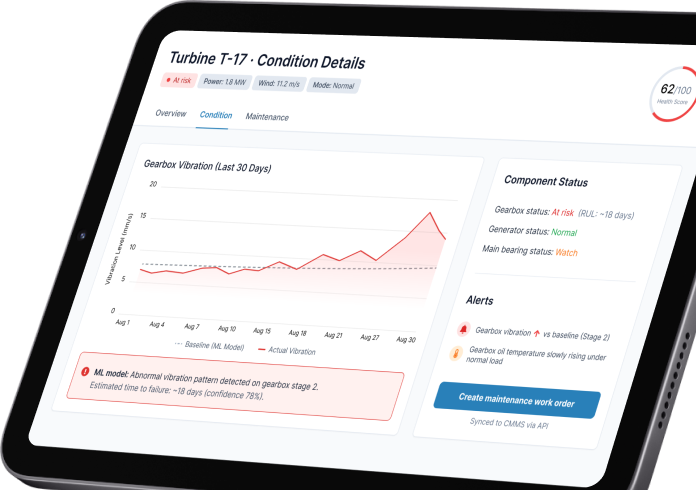


We brought in SumatoSoft to help us reduce unexpected turbine failures, and the result met our expectations. From the early stages, their team demonstrated a strong understanding of our business domain and the constraints of working with existing SCADA systems. They took a proactive approach, carefully analyzing our requirements and proposing a solution that enhanced our infrastructure without disrupting it. Communication was clear and structured, and the project was managed professionally, with all milestones delivered on time.

We’ve been working with SumatoSoft for a few years, starting from the initial monitoring system, so they already understood our environment quite well. At the same time, they still managed to surprise us with their professionalism.

We’d like to sincerely thank SumatoSoft for the work they’ve done on our maintenance system. At one point, our maintenance efforts became inefficient – long downtimes and rising repair costs became the norm.

When looking for a strategic IT-partner for the development of a corporate ERP solution, we chose SumatoSoft. The company proved itself a reliable provider of IT services.

The OEE reporting you asked for
The cell that caps your throughput runs on a controller the vendor retired two years ago. You have priced a spare and seen the lead time, so you have already drawn the conclusion. Inside that controller are the cycle counts, fault codes, machine states, and part-level timing you keep asking for. Every supported path to them comes back costed as a line replacement.
So the shift supervisor keeps a spreadsheet, quality keeps a second, and maintenance works from the supervisor’s copy while counting downtime on a different rule. That leaves you with three versions of a single record, which takes too much time to reconcile. The OEE reporting you requested 18 months ago is still unbuilt, because every attempt to scope it widens until it touches the line itself.
IT, meanwhile, asks what you intend to attach to the control network, and IT is right to ask. The narrow version of this project stands on its own, and the assessment draws its boundary.

IT/OT integration: what connects to the control network, and how
If you own IT/OT convergence, your objection to a project like this is specific and correct. The plant stands up connectivity you cannot see on machines you do not govern, and the exposure lands on your team.
We design for that from the assessment onward, rather than as a hardening pass afterward.
Segmentation and architecture
Zones-and-conduits design following IEC 62443, with the segmentation model documented in the assessment deliverable, before any device is connected.
Read-only by default
Data acquisition from the control layer runs one-directionally, through unidirectional edge gateways where the architecture calls for them. A write path requires explicit justification and sign-off.
No unmanaged OT
The assessment inventories what is already attached to the control network, including machines that arrived with a vendor laptop and never made it into anyone’s asset register. That inventory is yours to keep, whatever you decide about the build.
Your standards, your stack
We build on technologies your team can hire for and maintain. The handover includes source code, documentation, deployment scripts, and a knowledge-transfer session, so your team can run the system without us.
Start with a plant assessment
The assessment runs for 2 to 3 weeks at a fixed fee, and our engineers spend that time working through your equipment, systems, and data sources. You receive one document, written for the 3 people who have to agree before anything gets funded.
A machine-by-machine map of what is reachable, by which protocol, what needs a retrofit sensor, and what will stay manual. Plus the target architecture.
The cost of current downtime, the cost of the work, the payback period, and the scope that can be deferred without losing the payback.
The segmentation model, the data flows, an inventory of what is already connected, and the boundaries the build has to respect.
Then a scope and a fixed price for the build.
whether or not you continue with us. If the assessment concludes the project is not worth doing, that finding is the output, and you reached it for a fraction of a build budget.
What manufacturers ask before they call
Engineering: “Our equipment is too old to connect.”
Older machines expose more than their vendors admit, through the PLC, a serial output, a historian, or a retrofit sensor fitted without touching the control logic. Where there is no signal at all, we design around operator entry instead of pretending the data exists. The assessment sorts every machine into one of those categories before you spend anything on development.
Operations: “We can’t take the line down, and a previous pilot went nowhere.”
No line stops for our installation, because we build alongside production and cut over in planned windows. On stalled pilots: most of them collect data that no one owns. We scope backward from the decision the data supports, asking who reads it, when they read it, what they decide, and what changes afterward. When we cannot answer that, we say so rather than building it.
IT: “We don’t want another unmanaged connection into the control network.”
Neither do we. Segmentation and the zones-and-conduits model are part of the assessment deliverable, and read paths run one-directional by default. The architecture reaches you before anything is connected.
What custom manufacturing software costs
Assessment
Fixed fee, quoted within two business days of receiving your requirements. Most assessments fall inside a plant’s discretionary spend rather than requiring a capital request.
Build
Fixed scope and fixed price, produced by the assessment. Cost is driven by how many systems need integrating, whether machine-level data is involved, how many sites fall in scope, and whether the build runs against a live schedule.
Ongoing support
Monthly development and support for clients who keep extending after rollout. Optional, and your team receives everything needed to maintain the system without us.
Where we are a poor fit
Rolling engineering capacity billed by the hour and directed by your own managers. We offer that model elsewhere, and it is the wrong shape for this work, which is scoped and priced as a delivered system. We will say so on the first call.Your Line Already Produces the Data. Getting It Out Is the Project.
IP and delivery
You own the source code and the IP. Transfer occurs upon payment under the terms of the SOW, and the handover includes the repository, documentation, deployment scripts, and a knowledge-transfer session. Engineering is delivered from our center in Warsaw under EU data protection rules, with the company headquartered in Boston. We hold ISO/IEC 27001:2022 and ISO 9001:2015.
Frequently asked questions
How much does custom manufacturing software cost?
The SumatoSoft plant assessment is a fixed fee, and the build price is deducted from that assessment as a fixed amount. Cost drivers are how many systems need integrating, whether machine-level data is involved, how many sites are in scope, and whether the work runs against a live production schedule. SumatoSoft handles custom manufacturing software development for plants of 50 to 1,000 people across the US and EU.
What if our machines don’t output data?
Some machines do not. The SumatoSoft assessment sorts every machine into one of three categories: an accessible signal today, a signal available after a retrofit sensor, or a process best handled by operator entry. You receive that classification per machine before committing to a build.
Can you connect a PLC with no Ethernet port?
Usually yes. Serial PLCs connect to a modern data layer via a Modbus RTU-to-TCP gateway or an existing SCADA or historian that already polls them. A retrofit sensor reading the same condition from outside the control logic covers the rest. SumatoSoft confirms which route applies per machine during the assessment, rather than assuming one works.
What is the difference between MES and production monitoring?
Production monitoring reads what the line is doing and reports it: machine state, downtime reasons, output, and OEE. An MES directs what the line does next and maintains work orders, routings, operator instructions, and lot genealogy. Plants often need to be monitored first, because it costs less and establishes the data an MES would later depend on.
Do we need to buy sensors before you start?
No. The assessment establishes which machines already expose a usable signal. We specify retrofit sensors only where needed, and you see the count and cost before you commit. Buying hardware before the assessment usually means buying the wrong hardware.
Awards & Recognitions







Let’s start
If you have any questions, email us info@sumatosoft.com




