

AI-powered Predictive Maintenance software development
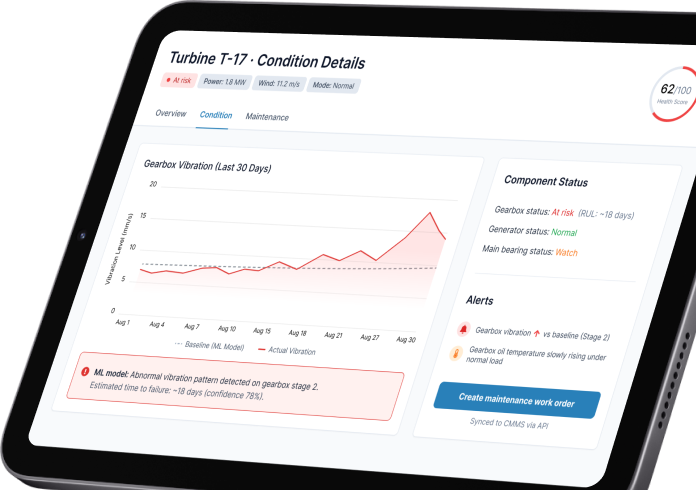
We design and develop predictive maintenance systems for industrial environments with legacy equipment, edge deployment, and modern AIoT architecture. We build locally hosted ML models, connect brownfield assets through secure gateways, and transform vibration, thermal, acoustic, and operational data into reliable maintenance signals your team can act on.





Predictive maintenance solutions we develop
Our predictive maintenance systems turn machine data into reliable, actionable maintenance workflows. Each solution is engineered around your equipment, infrastructure, and operational requirements.

Edge AI anomaly detection systems

Cloud-based predictive analytics platforms

Real-time alerting and maintenance orchestration

CMMS and ERP

Remaining useful life (RUL) prediction models

Multi-modal sensor fusion systems

Fleet-level asset monitoring

Custom dashboards and operator interfaces
Challenges SMBs Face with Predictive Maintenance
Predictive maintenance becomes effective when detection, infrastructure, and maintenance workflows operate as one system. In SMB environments, these areas require alignment before PdM delivers consistent operational value.

Unplanned downtime and emergency failures
Failures surface at the moment of breakdown, leaving no room for planned intervention.
We implement detection models that identify early deviations in equipment behavior, allowing maintenance teams to plan interventions ahead of failure and maintain production continuity.

Over-maintenance driven by rigid schedules
Maintenance follows predefined intervals rather than actual equipment condition, increasing unnecessary service activity.
We design condition-based systems that evaluate real-time equipment behavior and trigger maintenance only when it is operationally justified.

Limited visibility into actual equipment condition
Equipment performance is assessed without continuous, structured data, limiting the ability to track gradual changes.
We establish a unified data layer across assets, enabling continuous monitoring and consistent evaluation of equipment condition.

The rule-based false alarm trap
Threshold-based monitoring produces alerts that are not aligned with how machines actually operate, reducing signal reliability.
We deploy adaptive ML models that learn asset-specific behavior and generate context-aware alerts based on real operational patterns.

PdM disconnected from maintenance actions
Predictive signals remain isolated from execution, requiring manual interpretation and follow-up.
We connect detection outputs directly to maintenance workflows, linking signals with work orders, priorities, and scheduling systems.

The brownfield AI challenge
Existing equipment operates across mixed generations and protocols, limiting direct integration with modern systems.
We design edge-based architectures that integrate with legacy infrastructure, extract operational data, and enable predictive capabilities without disrupting existing processes.

Inefficient spare parts and maintenance planning
Uncertainty about when failures will occur forces companies to overstock spare parts or react too late when parts are unavailable. Both scenarios tie up capital and increase operational risk.

Subtle performance degradation goes unnoticed
Small changes in vibration, temperature, load, or efficiency often develop slowly and stay below alarm thresholds. Over time, these inefficiencies increase energy consumption, accelerate wear, and raise operating costs without obvious symptoms.

Unpredictable cost and ownership of PdM systems
SMB are cautious of PdM initiatives that become expensive to scale or require dedicated internal teams. Concerns about platform lock-in, rising subscription costs, and long-term support obligations often slow down or block adoption.
Request a proposal
Receive a detailed project estimate and timeline tailored to your specific industrial equipment and IoT sensors.
Our recent PdM works


The system has produced a significant competitive advantage in the industry thanks to SumatoSoft’s well-thought opinions.
They shouldered the burden of constantly updating a project management tool with a high level of detail and were committed to producing the best possible solution.

I was impressed by SumatoSoft’s prices, especially for the project I wanted to do and in comparison to the quotes I received from a lot of other companies.
Also, their communication skills were great; it never felt like a long-distance project. It felt like SumatoSoft was working next door because their project manager was always keeping me updated. Initially.

We tried another company that one of our partners had used but they didn’t work out. I feel that SumatoSoft does a better investigation of what we’re asking for. They tell us how they plan to do a task and ask if that works for us. We chose them because their method worked with us.

SumatoSoft is the firm to work with if you want to keep up to high standards. The professional workflows they stick to result in exceptional quality.
Important, they help you think with the business logic of your application and they don’t blindly follow what you are saying. Which is super important. Overall, great skills, good communication, and happy with the results so far.

Together with the team, we have turned the MVP version of the service into a modern full-featured platform for online marketers. We are very satisfied with the work the SumatoSoft team has performed, and we would like to highlight the high level of technical expertise, coherence and efficiency of communication and flexibility in work.
We can say with confidence that SumatoSoft has realized all our ideas into practice.

The Rivalfox had the pleasure to work with SumatoSoft in building out core portions of our product, and the results really couldn’t have been better.
SumatoSoft provided us with engineering expertise, enthusiasm and great people that were focused on creating quality features quickly.

SumatoSoft succeeded in building a more manageable solution that is much easier to maintain.

Thanks to SumatoSoft can-do attitude, amazing work ethic and willingness to tackle client’s problems as their own, they’ve become an integral part of our team. We’ve been truly impressed with their professionalism and performance and continue to work with a team on developing new applications.
We are completely satisfied with the results of our cooperation and will be happy to recommend SumatoSoft as a reliable and competent partner for development of web-based solutions

From the early stages of the project, SumatoSoft demonstrated a proactive attitude, actively seeking opportunities to enhance the solution and anticipate our needs. They consistently took the initiative to address any potential issues, provide timely updates, and offer solutions to challenges that arose during development. This proactiveness greatly contributed to the project’s success and exceeded our expectations.

Working with SumatoSoft has been an outstanding experience. Their team is not only highly skilled but also incredibly responsive, collaborative, and committed to delivering quality results. I can’t recommend them enough! Thank you team SumatoSoft for bringing my vision to life.

SumatoSoft is flexible, efficient, and extremely good at planning and being proactive. They have also been very proactive in their approach throughout the project, seeking to understand the needs and the reasons behind them before launching into development, which has been helpful for maintaining direction and consistency, especially because the end client is regularly generating new ideas for added features.

Frequently asked questions
How do you train a machine learning model if our machines haven’t broken down recently (lack of failure data)?
This is the cold start problem in PdM. We do not wait for failures. We use unsupervised anomaly detection algorithms such as autoencoders. The model is trained for 2-4 weeks on normal operating behavior. If telemetry deviates from this baseline, the system flags it as an anomaly.
If the factory loses internet connectivity, does the predictive maintenance system stop working?
No. We engineer offline-first edge AI. The quantized machine learning model runs directly on the local gateway. It continues monitoring, triggering local actions, and caching telemetry during outages. Data syncs with the cloud once connectivity is restored.
If we connect our legacy manufacturing equipment to a cloud AI for predictive maintenance, how do we prevent hackers from accessing the factory floor?
We do not expose operational technology to the public internet. We implement unidirectional data architectures using secure edge gateways. Telemetry flows outward for analysis, while inbound commands are blocked. External access to PLCs is not possible.
Should we use vibration sensors, acoustic monitors, or thermal cameras for AI predictive maintenance?
Relying on a single sensor creates blind spots. We implement multi-modal sensor fusion. Vibration detects mid-stage wear. Acoustic AI identifies high-frequency micro-cracks earlier. Thermal imaging reveals electrical imbalances. These signals are analyzed together to improve accuracy and reduce false positives.
How long does it take for the AI to learn our equipment’s baseline before it can predict failures?
Unsupervised autoencoder models typically require 14 to 30 days of continuous operation to establish a baseline. We also use transfer learning from similar assets to accelerate this process, allowing earlier detection of micro-anomalies.
AI-powered digital twin solutions
We build AI-powered digital twins of your critical equipment and production systems – virtual environments where operational behavior is continuously modeled, analyzed, and optimized.
What we implement
- Real-time synchronization between physical assets and their digital counterparts
- Simulation models reflecting machine behavior under varying loads and conditions
- Scenario testing for production changes, maintenance timing, and system stress
- Integration with predictive models to evaluate how detected anomalies evolve over time
How your team uses it
- Assess how increased production load affects asset lifespan
- Evaluate maintenance timing based on projected degradation patterns
- Test operational adjustments before applying them to live systems
- Understand system dependencies across production lines
Result
Operational decisions are supported by modeled outcomes, not assumptions.

Your team gains a controlled environment to evaluate changes, plan maintenance, and optimize performance with full visibility into system behavior.
Book a free consultation
Schedule a 30-minute call with a Senior IoT Architect to discuss your current infrastructure and predictive goals.
Predictive maintenance technology stack
Embedded & firmware (sensors, edge devices)
Used for data acquisition, low-power operation, and reliable signal capture.
Sensors & hardware interfaces
Retrofit-first, non-invasive by design.
Industrial & IoT connectivity
Chosen for coexistence with OT environments and unreliable networks.
Edge & gateway software
Responsible for buffering, preprocessing, and fault tolerance.
Embedded & firmware (sensors, edge devices)
Used for data acquisition, low-power operation, and reliable signal capture.
Sensors & hardware interfaces
Retrofit-first, non-invasive by design.
Industrial & IoT connectivity
Chosen for coexistence with OT environments and unreliable networks.
Edge & gateway software
Responsible for buffering, preprocessing, and fault tolerance.
Cloud & backend infrastructure
Designed for predictable cost and gradual scaling.
Data processing & analytics
Focused on early risk detection, not AI spectacle.
APIs & integrations
Critical for operational adoption.
Frontend & user interfaces
Built for technicians and supervisors, not analysts.
Security & access control
Aligned with operational risk, not compliance theatre.
Deployment & operations
Designed for long-lived systems.
Cloud & backend infrastructure
Designed for predictable cost and gradual scaling.
Data processing & analytics
Focused on early risk detection, not AI spectacle.
APIs & integrations
Critical for operational adoption.
Frontend & user interfaces
Built for technicians and supervisors, not analysts.
Security & access control
Aligned with operational risk, not compliance theatre.
Deployment & operations
Designed for long-lived systems.
AIoT maturity model
Predictive maintenance is implemented as a structured progression. Each stage introduces a specific capability that directly changes how maintenance decisions are made and executed.
 Level 1 – edge visibility
 Level 2 – predictive ML
 Level 3 – prescriptive AI
Level 1 – edge visibility
At the initial stage, the focus is on making equipment behavior observable in a consistent and reliable way.
We connect your machines and structure telemetry so your team can see how assets operate across shifts, loads, and conditions. This creates a stable operational baseline that becomes the reference point for all further analysis.
Your team works with a unified view of equipment performance instead of fragmented readings or manual checks.
Level 2 – predictive ML
With a baseline established, the system begins identifying patterns that indicate change.
Machine learning models learn how each asset behaves under normal conditions and highlight deviations that signal early-stage wear or instability. These signals appear before issues surface at the operational level.
Maintenance planning becomes proactive. Teams schedule interventions based on emerging patterns aligned with equipment behavior.
Level 3 – prescriptive AI
At this stage, detection is directly connected to execution.
When the system identifies a meaningful deviation, it prepares the corresponding maintenance action inside your operational workflow. Work orders, diagnostics, and required context are structured and delivered to the team in a ready-to-execute format.
Maintenance becomes a coordinated action supported by structured decisions and clearly defined operational steps.

Audit your infrastructure
Get a technical assessment of your current machinery to see if you are “IoT-ready” for predictive analytics.
How we deliver predictive maintenance software
We engineer predictive maintenance systems as structured platforms that integrate into your operations and scale across assets without rework.
We define where predictive maintenance delivers measurable impact. Equipment is prioritized based on failure cost, maintenance frequency, and operational criticality.
Sensor strategy is selected per asset – vibration, acoustic, thermal, or combined – with clear data ownership and integration boundaries.
We establish a reliable data layer across your environment. Sensors, PLCs, SCADA, and existing systems are connected through ingestion pipelines that support real-time and historical data flows.
Data is normalized, timestamped, and structured for consistent processing across assets.
The system is deployed on a controlled set of assets using live production data.
This phase validates signal stability, data consistency, and system behavior within your actual operating conditions.
Integration with maintenance workflows is tested end-to-end.
Machine learning models learn normal operating behavior at the asset level. Anomaly detection is tuned to reduce noise and surface early deviations that align with real failure patterns.
Each model is calibrated to the mechanical and operational specifics of the equipment.
The execution layer is defined based on your infrastructure and operational requirements. Edge deployment enables low-latency processing and continuous operation without connectivity.
Cloud deployment supports centralized analytics, cross-asset insights, and fleet-level visibility.
Predictive signals are embedded into your operational systems. Alerts trigger work orders, maintenance scheduling, and escalation paths inside CMMS, ERP, or internal tools.
Technician feedback is captured and fed back into the system for continuous refinement.
System performance is tracked across signal accuracy, response time, and maintenance outcomes. Models are refined as new data becomes available.
The platform expands across additional assets and facilities through a modular rollout aligned with your operations.
Operational security and data control
AI-driven maintenance systems operate inside critical industrial environments. We design every component with structured control, clear access boundaries, and full operational visibility.

Controlled data flow by design
Your operational technology (OT) environment remains isolated and stable.
We implement unidirectional data pipelines through secure edge gateways, where telemetry flows outward for analysis without exposing machines to inbound access.
This ensures:
- Stable operation of PLCs and industrial controllers
- Separation between production systems and AI layers
- Predictable, controlled data exchange

Edge-level processing and local decisioning
Machine-level intelligence runs directly at the edge.
Our Edge ML models process vibration, acoustic, thermal, and visual signals locally – enabling immediate anomaly detection and response without relying on constant connectivity.
This provides:
- Low-latency detection and action
- Continuity of operation in offline conditions
- Consistent system behavior across environments

Structured access and permission control
Every data interaction follows defined access logic.
We implement role-based and attribute-based access control across data pipelines, model interaction, and dashboards.
This ensures:
- Users access only relevant operational data
- Clear separation of roles across teams and systems
- Governed interaction with AI-generated insights

Full traceability of system actions
Every signal, prediction, and automated action is recorded.
We design systems with end-to-end auditability, enabling teams to trace how data moves, how models respond, and how decisions are triggered.
This provides:
- Transparent system behavior
- Verifiable AI outputs
- Operational accountability at every step

Secure integration with existing systems
Predictive maintenance becomes part of your existing workflow.
We integrate AI pipelines directly into CMMS, ERP, and industrial platforms through controlled middleware layers – without disrupting core systems.
This ensures:
- Stable integration with current infrastructure
- Consistent data exchange across systems
- Seamless adoption within existing operations

Data protection and compliance alignment
Data handling follows structured and controlled processes across the entire lifecycle.
We implement encryption, secure storage, and controlled data processing pipelines aligned with security standards.
This provides:
- Protection of sensitive operational data
- Consistent data governance across environments
Why choose SumatoSoft
We design PdM systems to fit real SMB conditions. Our solutions remain practical, controllable, and valuable as operations evolve, while we keep supporting our Clients with predictive maintenance development services.

Dual-engine engineering: software + AIoT in one system
We design predictive maintenance as a unified architecture – combining edge ML, cloud systems, and industrial data pipelines into one controlled environment.

Edge-first architecture for industrial operations
Machine learning models are deployed directly on your equipment through secure edge gateways, ensuring stable performance, low latency, and full control over operational data.

Production-ready systems from day one
We deliver predictive maintenance systems built for real operations – integrated into workflows, connected to your infrastructure, and ready for continuous use and refinement.

Seamless integration into your maintenance workflows
Predictive insights are delivered directly into your CMMS, ERP, and operational systems, transforming signals into structured maintenance actions your team can execute immediately.

Modular architecture that scales with your operations
Data collection, analytics, integrations, and interfaces are built as independent components, allowing your system to expand across assets and facilities without redesign.

Transparent systems your team can operate confidently
All signals, models, and workflows are structured, observable, and adjustable. Your team works with clear diagnostics and controlled logic aligned with daily operations.


Awards & Recognitions












Let’s start
If you have any questions, email us info@sumatosoft.com





