Case Study: IoT monitoring PoC for EU cold chain operator
Architecture consulting and proof of concept for real-time temperature monitoring across 15 refrigerated trucks and 3 warehouse zones, replacing paper-based end-of-trip checks and meeting EU GDP compliance requirements.
Project details:
About the Client:
The Client is a Netherlands-based food distribution company operating 15 refrigerated trucks and three warehouse zones across the Netherlands, Belgium, and Germany. Temperature monitoring relied on manual end-of-trip paper checks, leaving the Client with no visibility into cargo conditions during transit and no automated compliance trail for EU GDP obligations.
Location: Netherlands
Industry: Cold chain logistics
Team size: 5 specialists (IoT architect, backend developer, DevOps engineer, business analyst, QA engineer)
Project duration: 4 months
Business challenge:
The Client needed to replace manual end-of-trip temperature checks with continuous real-time monitoring across 15 refrigerated trucks and 3 warehouse zones. Additional challenges: the Client had no IoT infrastructure or in-house expertise to evaluate and select sensor technologies, connectivity models, and cloud architecture; GDP (Good Distribution Practice) compliance documentation requirements imposed audit-trail obligations that manual paper logs could not satisfy.
Our solution
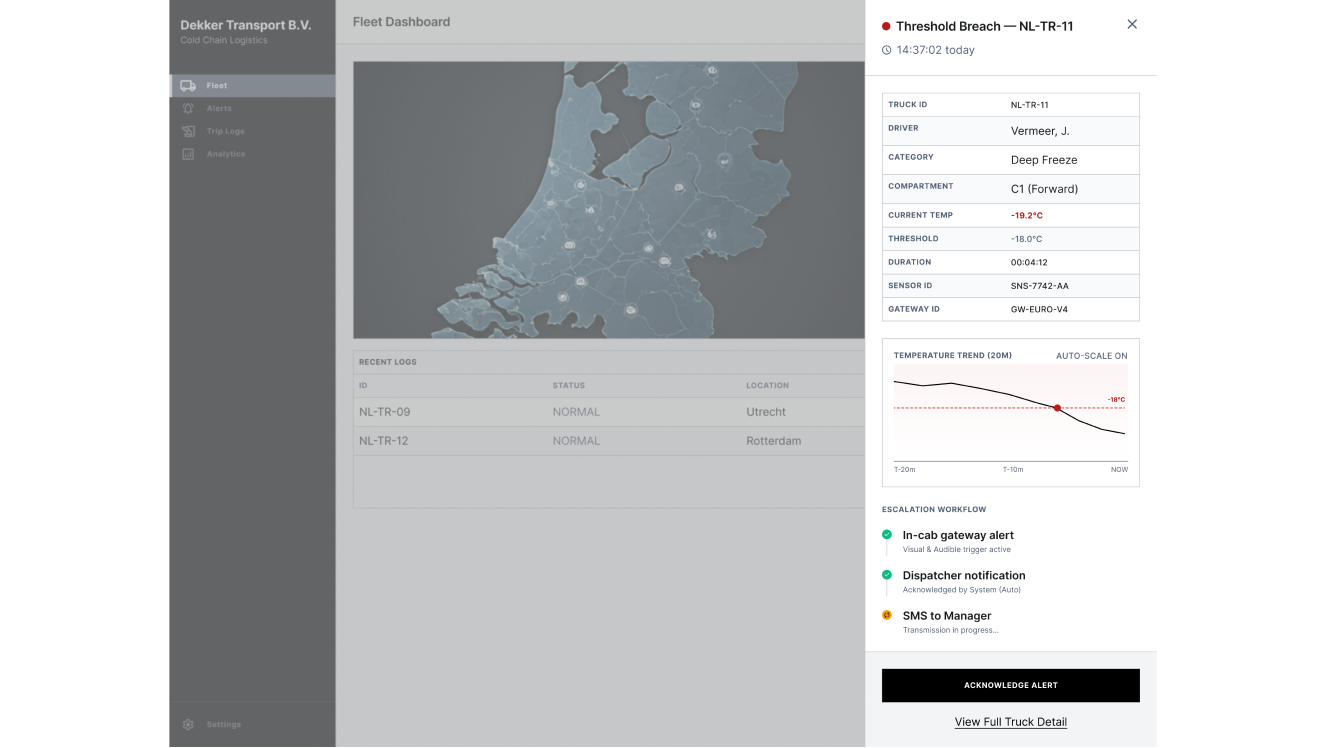
We structured the engagement in two phases: a 6-week architecture consulting phase and a 6-week proof of concept across 3 trucks and 1 warehouse zone. The architecture phase evaluated 5 sensor options and 3 connectivity models against cold-environment reliability, battery autonomy, LTE resilience, and unit cost. We recommended Ruuvi BLE tags paired with Teltonika FMB920 BLE-to-LTE gateways: a configuration that required no wiring changes to truck refrigeration units and came in 35% below the cellular-native alternative. The PoC then covered MQTT data pipelines on AWS IoT Core, configurable per-category temperature thresholds, a three-tier alert escalation path, and a Grafana dashboard with GDP-compliant trip logs.

Additional info about the case
Sensor selection driven by cold-environment testing
We evaluated vendors against four criteria: reliability at -22°C, 12-month battery autonomy, LTE connectivity resilience, and cost per monitored unit. The selected configuration met all four criteria at 35% lower per-truck cost than the initially preferred option, with the selection rationale documented and handed off for Client procurement.

Additional features:
- Per-product-category temperature thresholds (dairy, produce, frozen goods)
- Three-tier alert escalation: in-cab display, dispatcher dashboard, SMS
- GPS-correlated temperature logs exportable as EU GDP compliance records
- Battery-powered sensors with 18-month autonomy, no truck wiring required

Business value
Before:
- Temperature checks are performed manually at the end of each delivery trip
- Threshold breaches were discovered hours after the cargo left the temperature-controlled zone
- No automated documentation trail for EU GDP audit obligations
- Sensor and connectivity decisions deferred due to the absence of in-house IoT expertise
- Driver and dispatcher communication about temperature issues is limited to calls after delivery complaints
After:
- Temperature and humidity streamed continuously at 60-second intervals during transit and in warehouse storage
- Threshold breaches were detected and escalated to the dispatcher within 4 minutes
- Timestamped excursion records generated automatically per trip, GDP-compliant and exportable
- Architecture selected through structured evaluation of 5 sensors and 3 connectivity options, with documented rationale
- The three-tier escalation path notifies the dispatcher and the logistics manager without driver action