Case Study: The LPSolutions flat rate price book app development
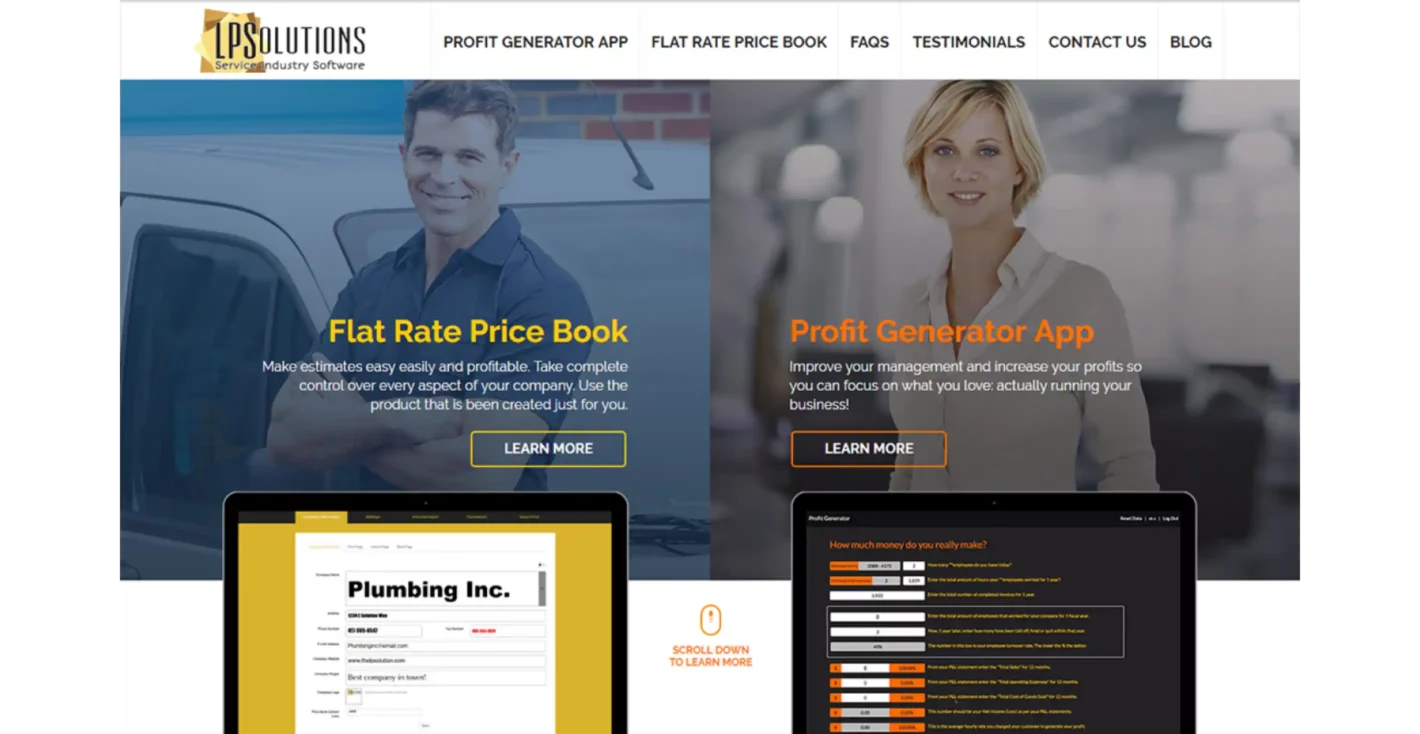
The LPSolutions Price Book is a service adding a new and innovative approach to creating and using a flat rate price book.
Business challenge
The Client wanted to develop a SaaS application enabling service businesses to standardize their flat-rate pricing and give owners clear visibility into the profitability of every job. The application was required to support role-separated access so owners could see profit per job while employees accessed only invoices and pricing lookups.
Additional requirements:
- Convenient and intuitive user interface
- High level of application security
- Fault tolerance under peak load
Our solution
The application comes up with an immediate pricing for specialty items not found in a regular flat rate price book. It is also possible to preview what a flat rate price book will look like prior to having it printed. Moreover, thanks to Employee/Owner login system, employees can double check invoices. This way, owners can see the profit per job that employees cannot see. As for the subscription fee payment methods, the solution accepts credit cards or PayPal.

Technological implementation
The other technological aspect worth mentioning is the redevelopment of Profit Generator App, the part of the LPS price book. The app used to be written in Python, now it has been brought to Ruby on Rails.
Besides the technological implementation, our team handled all the design works for the software. The use of ReactJS as a tool for UI development helped us to come up with a convenient user interface. Additionally, our quality assurance officer tested the solution before its release.

Distinctive features:
- edit the list of offerings;
- edit the list of articles;
- edit the list of employees;
- edit the list of employees’ relations;
- edit the appearance of price books;
- print price books.

Before:
- Service businesses set prices using memory or ad-hoc calculation, with no consistent rate reference across jobs
- Owners had no visibility into which jobs were profitable – job-level margin was opaque at the management level
- Estimating specialty items not in the standard catalog required manual research and calculation every time
- Price book updates were handled offline and required manual distribution to employees
After:
- Employees generate estimates from standardized flat-rate lookups, cutting estimate generation time by ~40%
- Owners see the profit per job in a role-separated dashboard; employees access only their invoices and pricing
- Specialty items are priced immediately from a built-in catalog, eliminating manual per-job calculation
- Rate calculations are automated by the Profit Generator, reducing pricing setup time by ~30%
Have an app idea?
Let’s start with a free quote!
See our other case studies
HRM system development


Fuelz aggregator web platform


MyMediAds – professional social network for online marketers





