Case Study: Freight Exception Resolution Agent for a European Forwarder
SumatoSoft built an event-driven agent that triages shipment exceptions for a Netherlands-based freight forwarder.
The agent pulls context from the TMS and the carrier feed, closing routine cases on its own while routing customs and detention risk to a coordinator.
Project details:
About the Client:
The Client is a Netherlands-based freight forwarder with 240 staff across 6 branch offices, moving road and short-sea shipments across Western Europe. Exception handling was done through a shared operations inbox, where coordinators triaged carrier delay notices by hand. Volume growth through 2025 slowed triage enough that detention charges became routine.
Location: Netherlands
Industry: Logistics and freight forwarding
Team size: 8 specialists (1 AI Architect, 2 ML Engineers, 2 Backend Engineers, 1 Frontend Engineer, 1 QA Engineer, 1 Business Analyst)
Project duration: 7 months
Business challenge
The Client wanted coordinators to stop triaging every carrier delay notice by hand. Leadership ruled out blanket agent authority early, because customs and detention risk attaches to a few exception types.
Additional requirements:
- Keep a named coordinator accountable for every exception the agent closes
- Hold the agent to the Client’s own carrier SLA terms rather than generic delay logic
Our solution
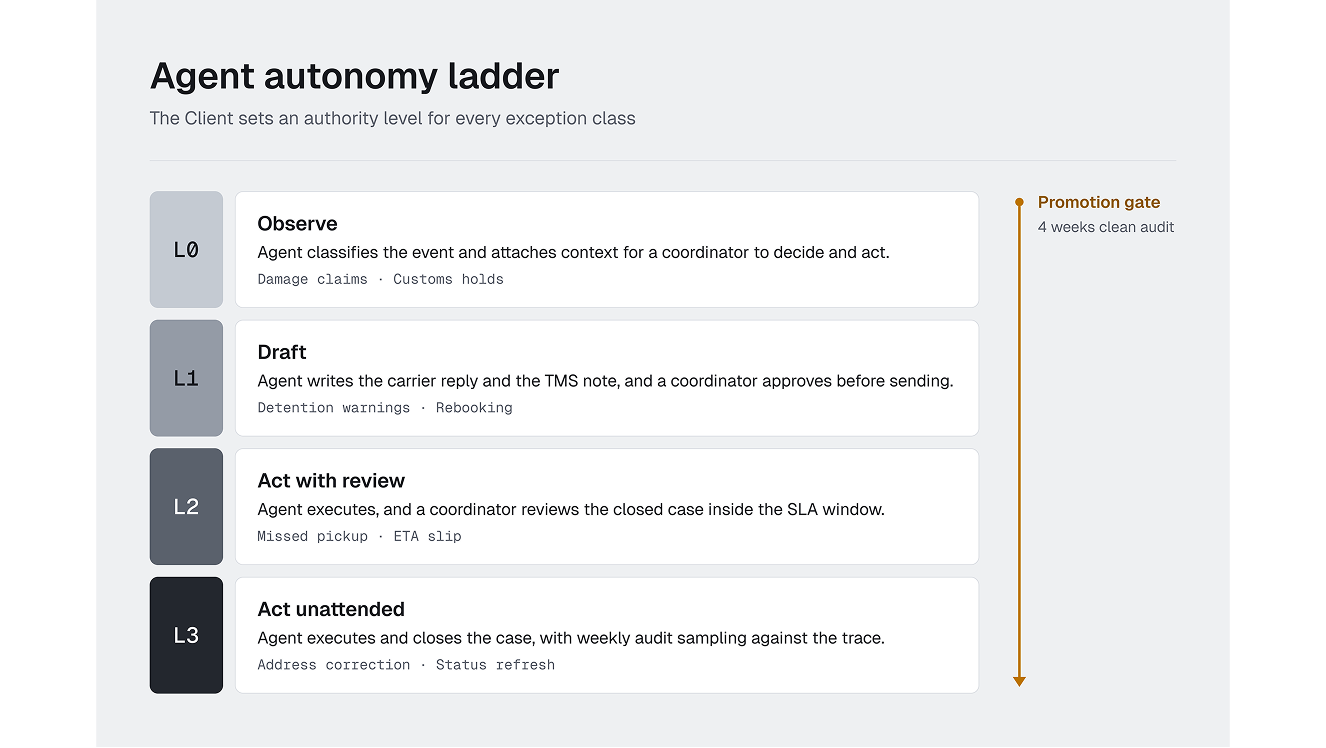
SumatoSoft delivered an exception-resolution agent that monitors the Client’s shipment event stream. When an exception fires, the agent classifies it and pulls related context from the TMS and the carrier feed. It then either resolves the case or hands it to a coordinator, attaching its reasoning. The Client sets authority by exception class, so the agent works unattended on address corrections while customs holds route to a human.
Agent autonomy graduated by exception class
The Client’s operations lead sets an authority level for every exception type before deployment. At the lowest level, the agent drafts a response and waits for a coordinator to approve it. At the highest level, it contacts the carrier, updates the TMS record, notifies the consignee, and closes the case. A class moves up only after four weeks of clean audit history.

Additional features:
- Authority level per exception class, configured by the Client
- Decision trace on every action
- Carrier SLA terms drive the resolution rules
- Coordinator override, with one-click rollback on any closed case
- Weekly precision review samples closed cases against the trace
Business value
Before:
- Coordinators triaged every exception by hand from a shared inbox, with median time to first action of 95 minutes.
- Detention and demurrage charges accrued while carrier delay notices waited for a coordinator to open them.
- Resolution steps varied by coordinator, and no record captured why a given exception closed the way it did.
- Branch managers had no view of exception volume by carrier until the monthly billing reconciliation.
After:
- The agent takes first action on covered exception classes within 45 seconds, and the ladder routes 34% of volume to a coordinator.
- Detention and demurrage charges on covered lanes fell by 21% over the 4-month measurement window compared with the pre-deployment baseline.
- Every closed exception carries a decision trace that records the events read, the rule applied, the action taken, and the coordinator response.
- Branch managers see exception volume by carrier and by class in near real time, which feeds the quarterly carrier SLA review.





