Case Study: AI integration of anti-fraud and underwriting for a fintech firm
A fintech company needed to integrate AI scoring into its application and transaction workflow. SumatoSoft linked risk sources, a feature store, and a decision engine to speed up decisions and improve the quality of anti-fraud controls.
Project details:
About the Client:
The Client is a mid-sized fintech company that issues consumer loans through its own digital channels and partner network. The business was growing rapidly, and the team needed to integrate AI into the application review process without losing control over risk and decision quality.
Location: Warsaw, Poland
Industry: Fintech
Team size: 7 specialists: 1 Solution Architect, 1 Business Analyst, 2 Backend Engineers, 1 Data Engineer, 1 ML Engineer, 1 QA Engineer.
Project duration: 16 weeks
Business challenge:
The Client was already receiving data from a payment gateway, a KYC provider, a credit bureau, and an internal CRM, but these data flows weren’t unified. Some checks were performed automatically, while others were performed manually. This meant applications took longer to process, and the manual review queue grew as business volume increased.
The company wanted to integrate AI into anti-fraud and underwriting, following a defined decision flow with reason codes, an audit trail, and secure handling of sensitive data. A separate requirement was to integrate AI into existing analytics processes.
Additional requirements
- Reduce the proportion of requests submitted for manual review
- Make automated decisions consistent with the specified SLA and maintain transparency for compliance and risk team
Our solution
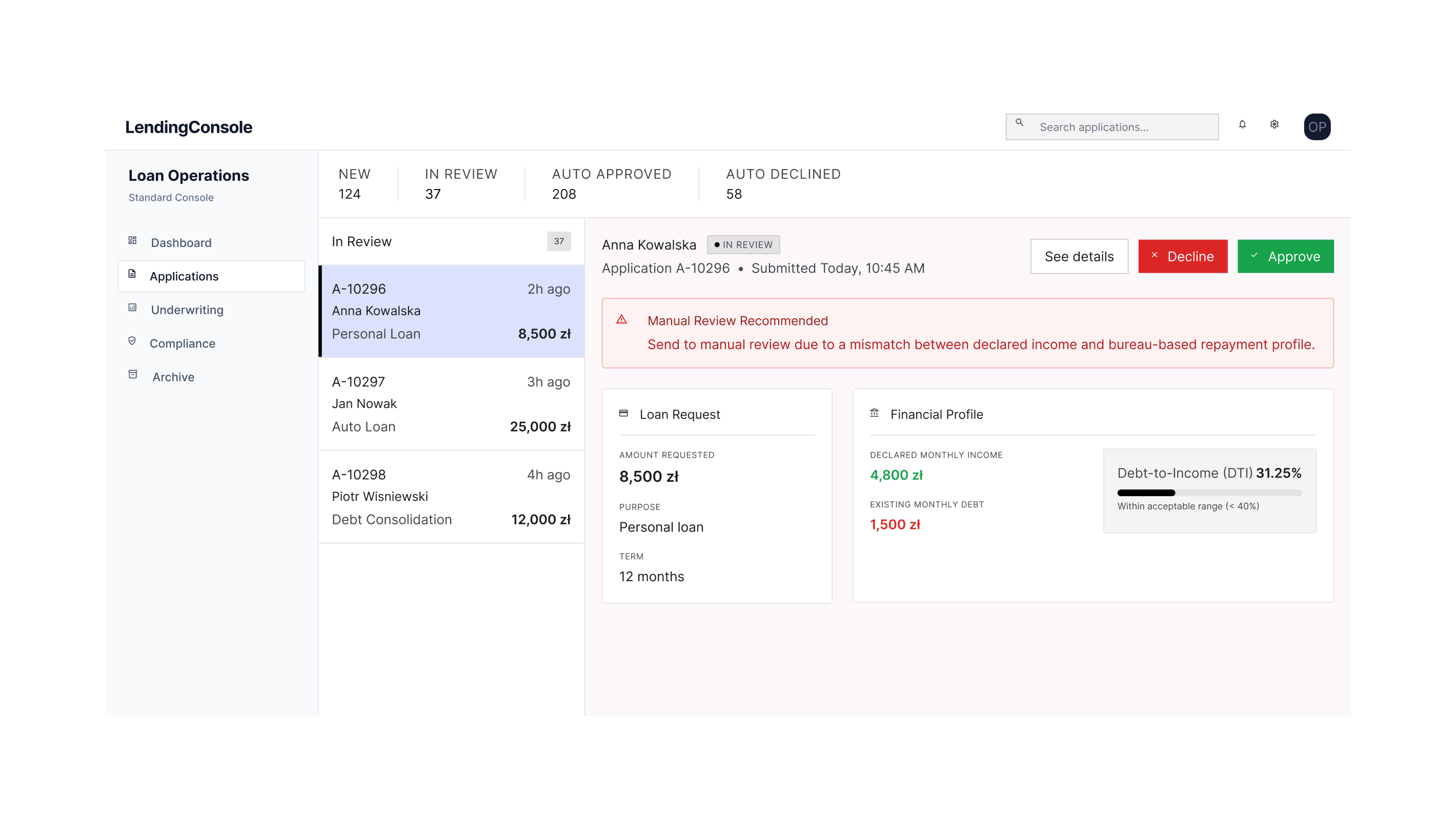
SumatoSoft built an integration framework for AI scoring by linking the request and transaction flows to external risk sources, configuring an event stream and an online feature store, and connecting two AI services: fraud scoring and underwriting scoring. On top of these, we built a decision engine with approve, review, and decline routes, as well as a workspace for manual review with reason codes and key request signals. We added outcome writeback for further model training, an audit trail for checks, latency and failure monitoring, and guardrails for sensitive indicators.
Additional info about the case
The project was launched on synthetic, anonymized data to safely test the AI’s logic and integrations before going live. The Client rolled out the solution in production in stages: first on a single product, then across a broader ticket flow.
Additional features
- Real-time AI scoring
- Decision engine with approve-review-decision routes
- Manual review workspace
- Reason codes and audit trail
- Monitoring latency and error rate

Business value
Before:
- Up to 44% of tickets were sent to manual review
- Resolutions often took more than a minute
- Analysts collected signals for the Client from multiple systems
- Fraud and underwriting worked as two loosely coupled processes
After:
- The share of manual reviews decreased to 27% in the pilot flow
- Decision time for 95% of applications dropped from 92 to 14 seconds
- All key signals and reason codes became available in a single interface
- Fraud scoring and underwriting scoring were integrated into a single decision flow with shared routing logic





