Case Study: RAG-based knowledge platform for a commercial real estate operator
An internal AI-powered knowledge platform for a commercial real estate operator managing a multi-property portfolio. The solution unified lease, vendor, maintenance, and compliance documentation into one retrieval layer with citation-based answers and role-based access.
Project details:
About the Client:
The Client is a US-based commercial real estate operator managing a portfolio of office buildings, mixed-use properties, and business parks across several cities. As the portfolio expanded, critical operational knowledge became scattered across multiple sources. The Client needed to make this knowledge usable in daily work across properties and teams.
Location: USA
Industry: Real estate
Team size: 6 specialists
Project duration: 4 months
Business challenge
The Client wanted to reduce delays in handling tenant, contractor, and property-related requests caused by scattered operational knowledge across multiple systems and teams.
Additional requirements:
- Turn fragmented operational knowledge from multiple properties into one usable system, while each building followed its own operating routines and key information was scattered across different teams.
Our solution
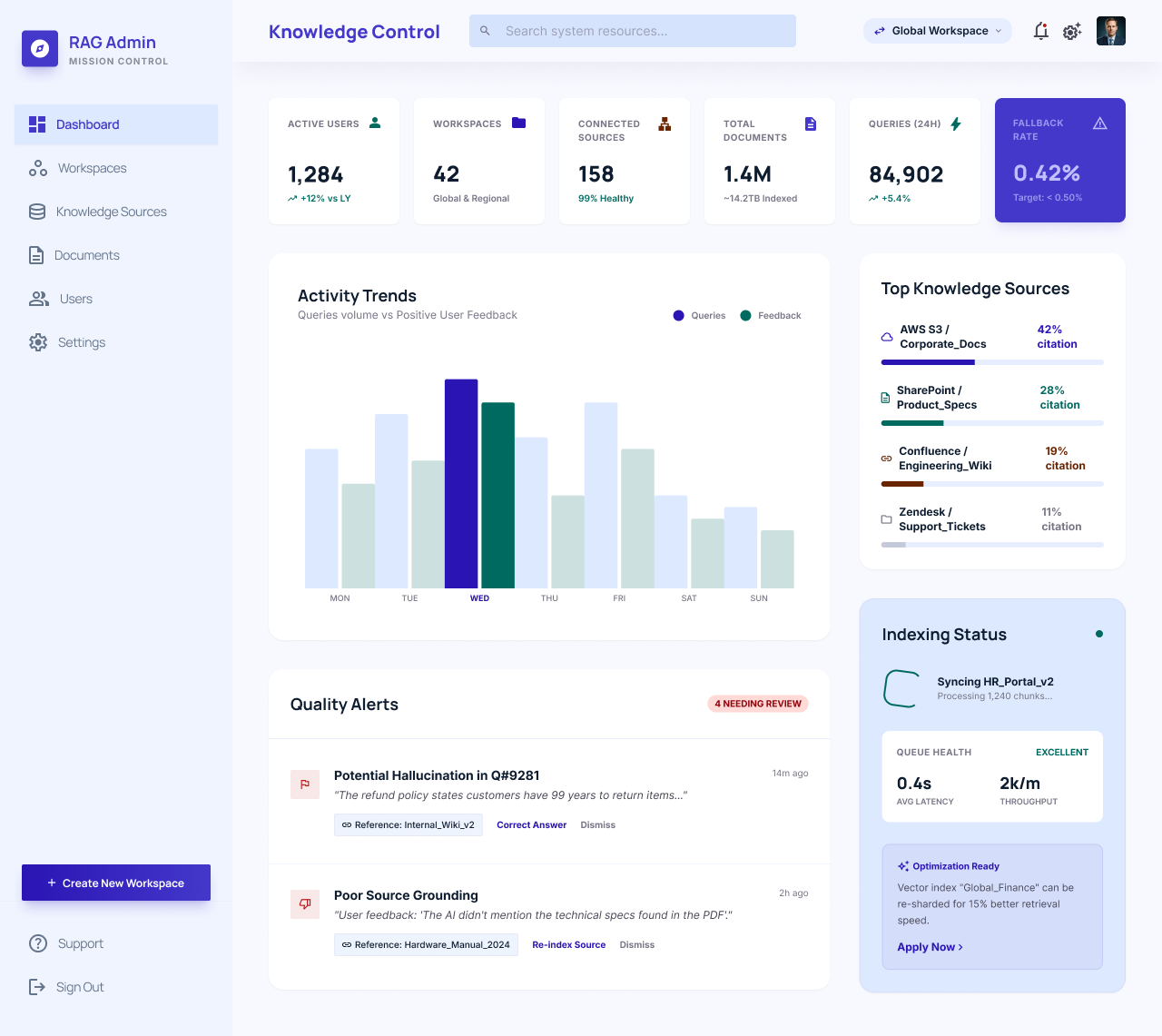
SumatoSoft developed a RAG-based operational knowledge platform for the Client’s internal teams. The solution connected all the company’s documentation into one retrieval layer and enabled employees to ask natural-language questions and receive answers grounded in internal documents. The platform facilitates daily operational use across property management, facilities, and support functions, with access controls applied at the retrieval level.

Knowledge preparation for property-aware retrieval
This was the most challenging part of the project, because we had to turn fragmented, inconsistent, and property-dependent operational knowledge into one production-ready retrieval foundation. To do so, we interviewed and collected materials from five Client-side groups involved in different daily property operations, validated and deduplicated the materials, preserving local building logic, and structured content access so each team could retrieve only the information relevant and permitted for their roles in daily operations.

Additional features:
- Citation-based answer generation
- Role-based retrieval and access control
- Separation of portfolio-wide and local procedures
- Hybrid retrieval architecture
- Fallback responses when information is unavailable
- Support for lease, vendor, maintenance, and compliance documentation
- Monitoring and answer-quality tracing
- Web interface for internal operational teams

Business value
Before:
- Operational knowledge was scattered across multiple systems, teams, and properties, which delayed responses to tenant, contractor, and property-related requests.
- Employees had to manually search for information across repositories and rely on different teams to clarify procedures.
- Portfolio-wide rules and building-specific procedures were mixed, which reduced operational accuracy in day-to-day work.
- As the portfolio expanded, there was no system to make operational knowledge consistently usable across all buildings and teams.
After:
- Operational knowledge was unified into one internal platform, cutting the time employees spent retrieving information to handle tenant, contractor, and property-related requests by 45%.
- Employees query one interface to ask questions in plain language, review cited sources, and retrieve what they need without manual cross-checking across teams and repositories.
- The system returns information in the context of a specific property, with portfolio-wide rules and building-specific procedures separated and access applied according to user role.
- The platform was deployed across 18 commercial properties, giving the Client a consistent, scalable retrieval foundation that covers the whole portfolio.





