Case Study: Remote simultaneous interpretation web platform for conferences
A platform designed and developed as a tool by interpreters and for interpreters, promising a unique and tailored experience to its users.
Project details:
About the Client:
Our Clients, a group of professional interpreters, operating in Belgium, were forced to move online during the COVID pandemic.
- Location: Belgium.
- Industry:
- Online conferencing.
- Team size: 8 team members.
- Project duration: 1 year.
Business challenge
They reviewed all major online tools on the market that were suitable for interpreting at big conferences and were left unsatisfied by their features and overall user experience. Recognizing the limitations of these existing solutions, they decided to pioneer their own. This led to the inception of a project aimed at building a platform tailored for interpreters, by interpreters.
Additional requirements:
- design an online system familiar to interpreters accustomed to offline work;
- translate the experience of offline interpreters to the digital world;
- build a platform architecture capable of handling large-scale online conferences without sound overlapping or interference.
Our solution
During the Discovery phase, we undertook a detailed study of offline interpreters’ equipment and existing online tools, leading to the identification of four user roles: Moderator, Speaker, Listener, Interpreter. Understanding these roles allowed us to map out the necessary features for each user type, and lay the groundwork for the minimum viable product (MVP) design.
After defining MVP, we conducted a proof of concept to ensure that it was possible to construct a multichannel system for interpreting considering the technical requirements of the Client. Next, we entered the prototyping stage, focusing on adapting the offline system familiar to interpreters to the web realm. We built a platform that can host online conferences with an unlimited number of listeners from a multinational audience without any language barriers.

Multichannel audio system at the core
The development of the multichannel system was the most complex part. This system allows interpreters to switch between different audio channels for translation, mirroring the functionality of offline interpreting devices. It was crucial to ensure seamless audio transmission without interference, catering to multiple languages simultaneously.

Additional features:
- event creation and management;
- role-based functionality for Moderator, Speaker, Listener, and Interpreter;
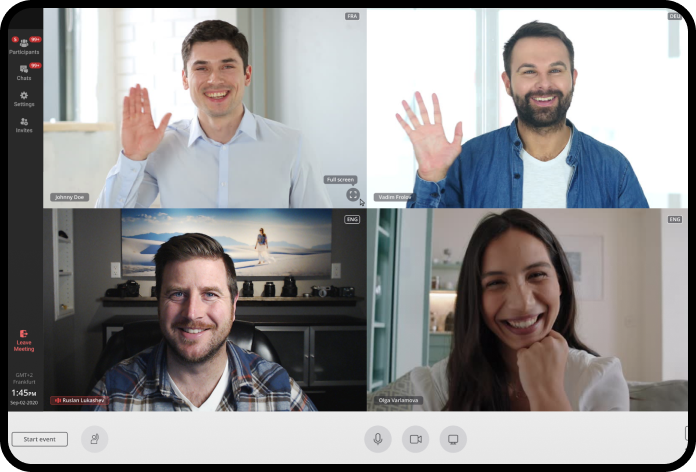
- video streaming in various modes;
- integrated chat system with file sharing and messaging;
- participants search feature.

Before:
- Limited online tools for interpreters, unsatisfactory user experience in existing solutions
- Lack of a system that mirrors offline interpreting experience
- Difficulty in managing large-scale online conferences with multiple languages
- No distinction between user roles within the conference, requiring all participants to navigate the same interface regardless of function
After:
- Interpreter onboarding ~40% shorter than with incumbent RSI tools, enabled by a UI built around familiar offline console controls
- ~30% fewer session errors from audio channel confusion – the multichannel architecture mirrors physical interpreter devices without cross-channel interference
- Large-scale multilingual conferences hosted with no audio channel conflicts and unlimited concurrent listeners
- Role-based interface for four user types – Moderator, Speaker, Listener, and Interpreter – each seeing only the controls relevant to their function
Have an app idea?
Let’s start with a free quote!
See our other case studies

Beroon – online auto catalog for the Iranian market

GGSWP – web platform for online gaming tournaments


Dexai Robotics: graphical user interface for robot operatio