Case Study: Medical transportation platform for a leading NEMT provider
Two years of collaboration to enhance the platform of a leading medical transportation service provider in the USA and the United Kingdom.
Project details:
About the Client:
Our Client is a leading provider of mobile medical services and transportation in 26 US States and in the United Kingdom. Around 1000 enquiries for cars are coming to the application per day in 6 States. The company primarily targets the B2B sector, catering to healthcare organizations. Their product is a tech-enabled platform that consists of 4 interconnected applications. Amidst the COVID-19 pandemic, the Client aimed to expand their platform’s scope with new features.
- Location – USA
- Industry – Healthcare
- Team size – 12 specialists (5 full stack developers, 2 iOS developers, 1 PM, 1 Head of QA, 2 QA, 1 DevOps, 1 Director of engineering)
- Project duration – 10 months
Business challenge
The unclear interdependencies among their four applications posed a challenge for any code changes. The Client engaged SumatoSoft to develop new trip types and optimize the existing codebase, enhancing overall system scalability.
Our solution
We provided staff augmentation services to join the existing development team of our Client, a leading medical transportation service provider. Our role was to seamlessly integrate into their team structure and accelerate the development process. This collaboration involved enhancing the app’s functionality by developing new trip types for on-site COVID-19 testing and trips with custom number segments for increased flexibility. Additionally, we undertook a significant task of debugging and refactoring the existing codebase to improve its scalability and adaptability, ensuring the system’s readiness for future expansions and modifications.
New types of trip development
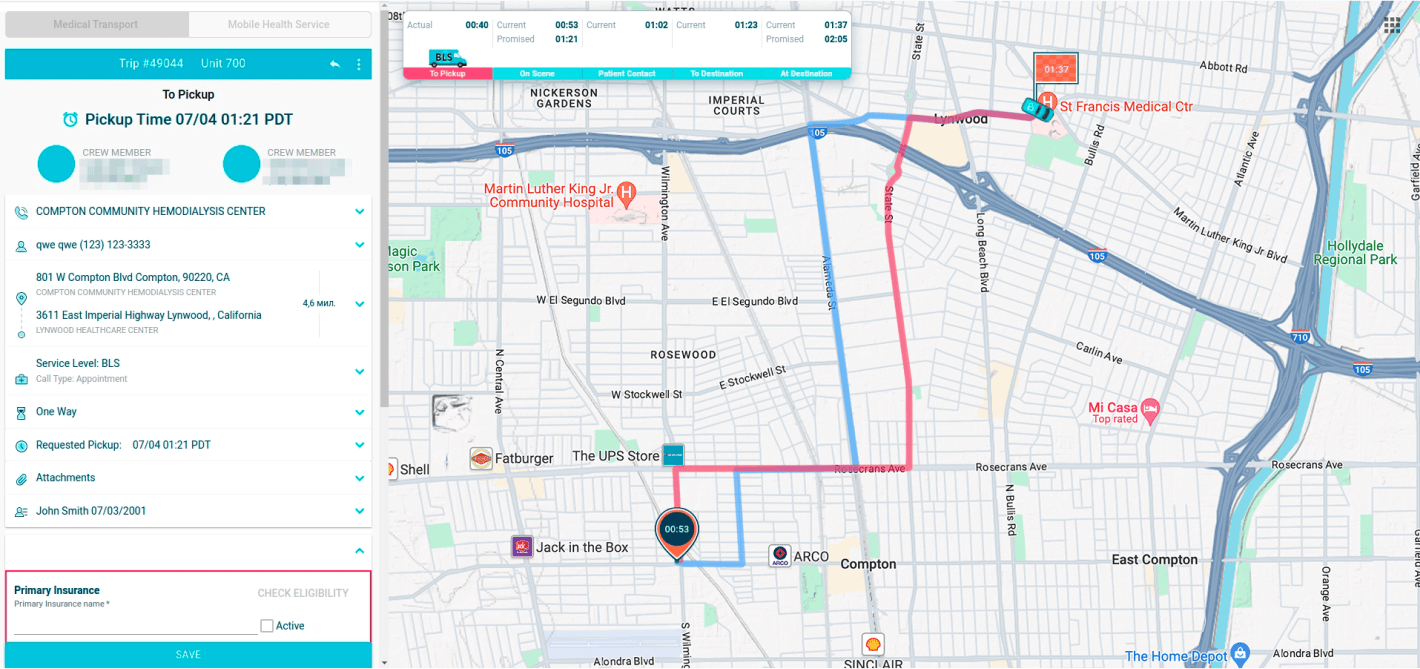
In general, every trip within the system consists of several logical segments or events. We developed two unique types of trips, each one requiring a different set of segments. The first type of trip catered to on-site COVID-19 testing. Medical personnel, alongside a driver, would travel from point A to point B and wait while the sample collection took place. The second type of trip aimed at enhancing flexibility by offering trips with custom number segments, designed for situations that did not fit the existing models, thereby broadening the utility of the app.

Additional features:
- customized call specifications;
- flexible transport calling;
- smart route calculation;
- separate statistics for COVID testing trips.
Business value
Before:
- The platform’s four interconnected applications had unclear interdependencies, making each code change time-consuming and prone to cascading bugs.
- No trip type existed for non-passenger medical operations, limiting the platform’s ability to accommodate emerging service models such as on-site testing.
- Each new feature addition introduced defects that were difficult to isolate across the tightly coupled applications.
- Non-passenger trips shared the same statistics pool as regular trips, causing data mix-ups in dispatch reporting.
After:
- We refactored all four applications, mapping interdependencies and reducing feature integration time by ~40%
- Two new trip types – on-site COVID-19 testing and custom-segment trips – extended the platform’s service range, enabling the Client to respond to new operational demands without architectural rework.
- With explicit interdependency mapping in place, defect isolation became straightforward and new feature additions no longer cascaded into unrelated parts of the system.
- Dispatchers gained a separate statistics view for non-passenger trips; the refactored platform now handles 1,000+ daily trip requests across 26 states with greater operational stability.
Have an app idea?
Let’s start with a free quote!
See our other case studies

Fuelz aggregator web platform


Hauz web portal & eCommerce platform


Dexai Robotics: graphical user interface for robot operatio