Case Study: Fitness tracking system development
A smartwatches app for fitness trainers that detects nearby clients and shows detailed info about them and their activity.
Project details:
About the Client:
Owner of a fitness club.
- Location: USA.
- Industry: Health & Fitness.
- Team size: 4 specialists (1 Project Manager, 1 Mobile Developer, 1 Designer, 1 Business Analyst).
- Project duration: 3 months.
Business challenge
A Client has a fitness club, where they hold 1-hour classes. In their work, they try to create a “family-like” approach where knowing each Client’s name and background is of high importance.
But for obvious reasons, trainers can’t remember all the Clients’ names and their info. So they came up with an idea of building an app for smartwatches that will be worn by trainers to detect the Clients that are standing nearby, via wristbands, and displays detailed info about the Clients – name, injury type, age, photo.
The app should connect to CRM, and select fields in the CRM, that should be displayed in the app.
Our solution
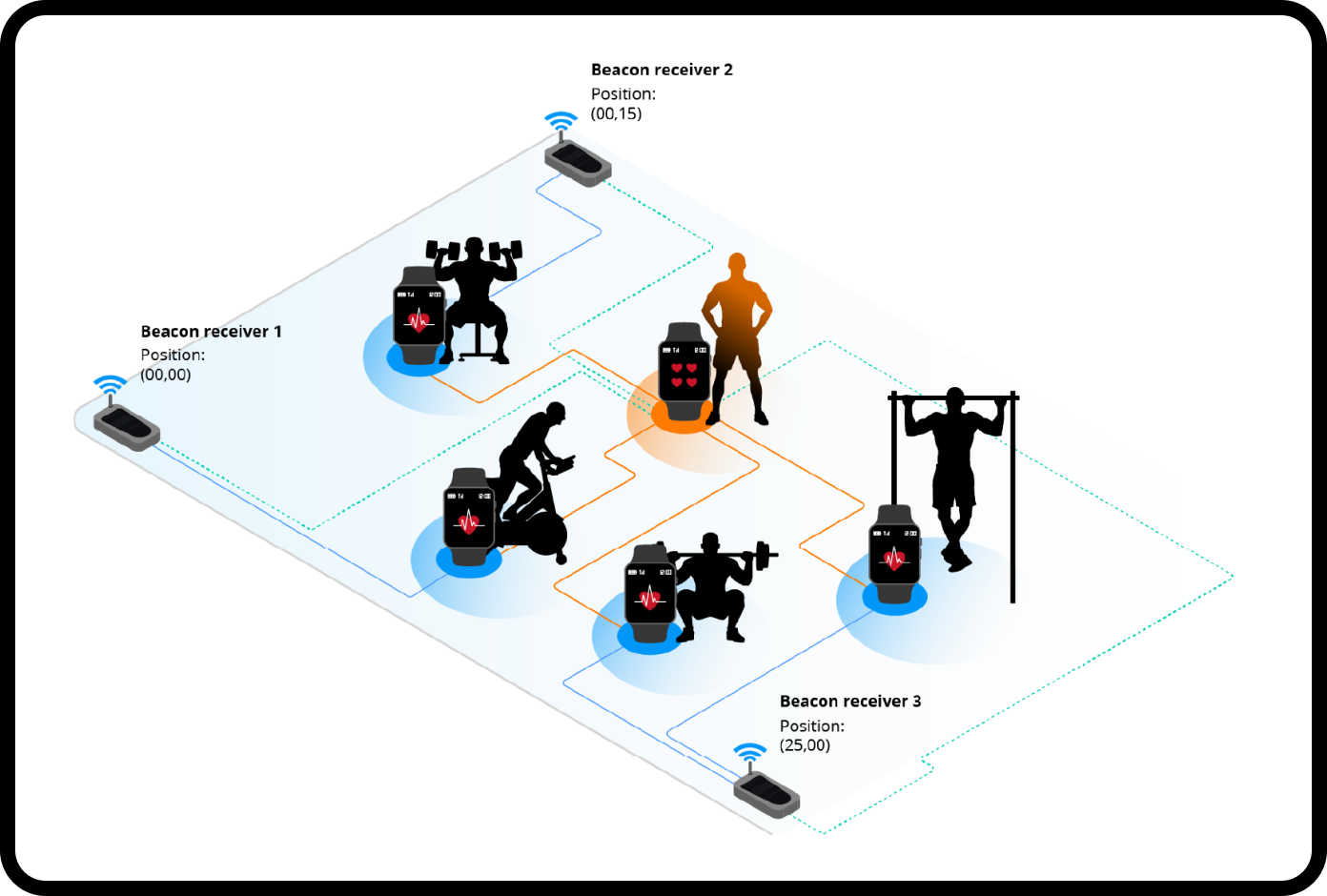
3 iBeacon receivers were placed in a gym with predefined positions (coordinates) around the perimeter of a gym on the height above all physical obstacles.
Each visitor with their wristband acts as an emitter of a BLE (Bluetooth low energy) signal. Beacon receivers obtain this information from each reachable wristband and transmit it to a server (over HTTP or MQTT or web sockets).

How it works:
The server receives the package (which primarily consists of device ID and RSSI – signal strength value) and starts the preprocessing phase (smoothes the noise with Kalman or average filtering). Then it prepares data for positioning calculation; this procedure is performed with trilateration technique (that’s why we use at least 3 beacon receivers). All intermediate and final data are stored in the database. In this way, we have a map with coordinates of all beacons.

Business value:
- No need to carry a phone to detect the closest Client;
- Reducing the impact of physical obstacles on a signal
(noise reduction); - Possibility to detect the exact location of each beacon
at a particular moment; - Low cost of setup equipment;
- Simultaneous support of multiple trainers;
- Statistic calculation of Clients’ activity (heatmap, etc.).
Before:
- Trainers had no way to automatically identify which member was nearby – recognition relied entirely on memory or asking the member directly
- Member health details (injury type, age, history) were unavailable during class without stopping to check a phone or clipboard
- There was no system tracking where members spent most of their time on the gym floor
- Trainers spent time before each session manually reviewing CRM records or trying to recall individual client profiles
After:
- Trainers see every nearby member’s full profile on their smartwatch the moment they come within range – 100% of class interactions start with personalized context, no asking or memory required
- Name, injury status, age, and photo surface automatically from the CRM to the trainer’s wrist during live class
- A real-time gym heatmap shows management which equipment is most used, which stations are idle, and how members move through the space
- Pre-session client preparation time cut by 40% – all client context is delivered to the wrist automatically before the first interaction
Have an app idea?
Let’s start with a free quote!
See our other case studies
CRM system testing
WeChat-integrated e-commerce platform for the Asian market


Transportation management system




