










Engineering that brings business results. Partners you can trust.
SumatoSoft succeeded in building a more manageable solution that is much easier to maintain. Their project management reflects the excellence of a larger company. Their team delivers high-quality results, attentive service, and reasonable pricing.

The system has produced a significant competitive advantage in the industry thanks to SumatoSoft’s well-thought opinions. They shouldered the burden of constantly updating a project management tool with a high level of detail and were committed to producing the best possible solution.

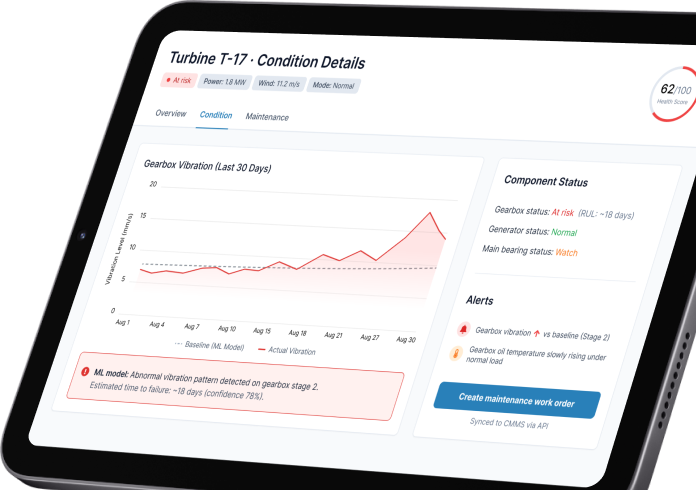
We brought in SumatoSoft to help us reduce unexpected turbine failures, and the result met our expectations. From the early stages, their team demonstrated a strong understanding of our business domain and the constraints of working with existing SCADA systems. They took a proactive approach, carefully analyzing our requirements and proposing a solution that enhanced our infrastructure without disrupting it. Communication was clear and structured, and the project was managed professionally, with all milestones delivered on time.

Rivalfox had the pleasure to work with SumatoSoft in building out core portions of our product, and the results really couldn’t have been better.
SumatoSoft provided us with engineering expertise, enthusiasm and great people that were focused on creating quality features quickly.

SumatoSoft is flexible, efficient, and extremely good at planning and being proactive. They have also been very proactive in their approach throughout the project, seeking to understand the needs and the reasons behind them before launching into development, which has been helpful for maintaining direction and consistency, especially because the end client is regularly generating new ideas for added features.

We tried another company that one of our partners had used but they didn’t work out. I feel that SumatoSoft does a better investigation of what we’re asking for. They tell us how they plan to do a task and ask if that works for us. We chose them because their method worked with us.



Services we provide
We build two kinds of systems. The first is stable, scalable software that runs your mission-critical operations. The second is governed AI that pushes automation and intelligence further than before.
We don’t just build software. We help your business succeed in a digital-first world. We pair advanced AI with open, transparent collaboration to create solutions that deliver real results.



Our dual-engine approach and principles
Regular software gives the same output for the same input. AI answers from context, so we test, price and monitor it differently.

Architecture that checks AI answers for made-up facts

Financial governance built-in

Secure by architecture

Innovation without losing control

Multi-modal AI architecture
| Engineering dimension | Traditional SDLC | Agentic ADLC |
|---|---|---|
System logic model |
Rule-based logic (deterministic) |
Output depends on context (probabilistic) |
Quality assurance method |
Manually controlled QA cycles |
Algorithmic AI evaluation (RAGAS, LLM scoring) |
Cost governance model |
Static infrastructure cost |
Token consumption forecasting |
Release & Stability model |
Versioned releases |
Continuous AI evaluation & guardrail tuning |
Input–output behavior |
Input – Fixed Output |
Input – Context Retrieval – Controlled Output |
How we keep AI data private and costs predictable
Adopting AI should give you more operating power without giving up security, accuracy, or predictable cloud costs. We engineer AI that is secure by design, predictable to budget for, and controllable once it’s live.

Your data stays inside your boundary
Your proprietary data never trains public models. Everything runs in isolated environments, with strict access controls, encryption both in transit and at rest, and a zero-retention policy. Your intellectual property stays protected at every stage.
- We deploy AI systems inside secure, VPC-isolated cloud environments (Azure OpenAI, AWS Bedrock) or privately hosted open-source models.
- Your documents, databases, ERP records, and internal knowledge bases are indexed into private vector databases under strict role-based access control.
- The language model processes your context with zero data retention.
- For regulated industries, we support fully private or hybrid deployments.
- ISO 27001 and ISO 9001 aligned security processes.

Prove value before you scale
Structured planning rules out blank-check spending and runaway token costs. Before full development starts, we run a pilot & prove engagement.
- We simulate your expected usage, project your monthly token consumption, and model infrastructure costs under different loads.
- We tune the prompts and architecture to bring those costs down.
- Your leadership team gets a total cost of ownership projection before committing to rollout.
- The pilot demonstrates measurable impact (reduced manual workload, faster cycle times, operational savings) before you scale.

Human-in-the-loop control
Autonomous agents work inside clear rules you define. Into every system we deploy, we build strict guardrails and a way for a person to step in.
- Answers stay grounded in fact.
- Permissions follow each user’s role.
- The system scores its own confidence, routes sensitive actions to a human for approval, and faces adversarial testing (red-teaming) before it ever reaches production.
If the model does not have sufficient context, it is engineered to respond with “insufficient information” rather than generating unsupported content.

Built for enterprise trust
Security is the foundation of every deployment. From the moment data comes in, we mask personal information (PII), then monitor and score the system continuously. Every system is built under our Agentic Development Lifecycle (ADLC), a structured way to engineer probabilistic AI safely. You gain:
- Controlled innovation.
- Financial predictability.
- Compliance alignment.
- Operational oversight.
AI accelerates your organization while preserving governance.

Get a Free Project Estimate
Share details about your project and get a detailed proposal.
Industries we help
Every industry still runs on legacy systems, and every industry now faces an AI-driven shift. We help you modernize safely by pairing disciplined software engineering with AI systems you can govern.

Healthcare
We build secure clinical platforms, patient portals, and IoT-enabled monitoring systems, then enhance them with HIPAA-compliant AI assistants that summarize medical documentation, support clinical trial matching, and analyze operational workflows. All AI systems operate inside private, access-controlled cloud environments with strict governance and evaluation controls.

Manufacturing and energy
Industrial environments demand reliability. We build IoT and predictive-maintenance platforms with AI that reads sensor data, flags anomalies, and lets your engineers query operational data securely. Every deployment stays isolated in a secure cloud, so your industrial intellectual property is protected.

Logistics & Transportation
We engineer transportation management systems and supply chain platforms, then extend them with AI-driven forecasting, document retrieval, workflow automation, and ERP-integrated agents. Because we build both the core software and the AI layer, modern intelligence connects directly to existing operational infrastructure.

Finances and insurance
Financial platforms demand auditability and regulatory compliance. We develop secure fintech systems and integrate governed AI for underwriting support, regulatory document retrieval, fraud analytics, and policy summarization. Through our ADLC framework, every model is evaluated for accuracy, cost predictability, and risk exposure before production deployment.

Education
We build learning platforms and integrate secure AI capabilities that support grading, institutional knowledge retrieval, and performance analytics. Architects prioritize privacy, governance, and institutional control.

Marketing & Advertising
We build effective Client relationships with marketing automation tools that help optimize strategies, gather insights, and achieve ambitious goals.
Core tech stack we work with














Why companies work with SumatoSoft

Full transparency
You can see the whole process from day one. Before development starts, we agree on a clear roadmap, measurable goals, how often we report, how we sync, and how we’ll test. That way you always know what we’re building, how we track progress, and what success looks like. Transparency is simply how we work.

Client involvement
Every organization runs delivery its own way. Some want us to handle everything; others want to stay closely involved. We adapt to whichever you prefer, while keeping the same engineering discipline underneath. We fit into your governance and keep things predictable and accountable.

AI-optimized cost efficiency
We use AI-assisted engineering to speed up development and automate repetitive work without cutting corners on quality. You get to market faster and use resources efficiently, while we keep investing in sharper engineering.

Accurate scoping that protects outcomes
Good software starts with precise scoping. Working with you, we dig into the details to clarify your business goals, rank features by priority, and set a realistic roadmap. That groundwork keeps scope from ballooning, holds the budget in check, and protects delivery over the long run.

Thoughtful resource planning
The right team makes or breaks a project. Because most of our engineers are senior, we can match real expertise to the complexity of your work and the context of your business. We size the team to the job and align it with what delivery actually needs, so execution stays balanced and efficient.

Proactive risk management
We manage risk on purpose, not by reaction. Throughout the project we watch the operational, technical, business, and external factors that could affect delivery. We catch threats early, write down how we’ll handle them, and keep project health visible the whole way. With AI in the mix, that same discipline covers model evaluation, security, and cost forecasting.

Structured change management
Requirements shift on any serious software project. We handle that through a clear process. We log every change, weigh it for feasibility and impact, and prioritize accordingly. You stay adaptable without putting the timeline or the quality at risk.

Building on strong values
Sustainability Commitment
We are committed to supporting sustainable growth and contributing to a better future. As proud members of the Council for Inclusive Capitalism, we integrate sustainable practices into our projects and operations, prioritizing long-term solutions that positively impact the environment, society, and economy.
Client-Centric Approach
Our Clients are at the heart of everything we do. We work tirelessly to understand their needs, exceed their expectations, and deliver solutions that align with their business goals, ensuring long-lasting and mutually beneficial relationships.
Security and Confidentiality
We are certified to ISO 9001 and ISO 27001, the top international standards for information security. From day one we sign an NDA, turn on safeguards like two-factor authentication on internal systems, and hold our employees to strict confidentiality rules. We take every step needed to keep your business data secure.
Cultural Sensitivity
We respect and adapt to the cultural nuances of our Clients, employees, and partners. We operate internationally in regions like the USA, EU, Africa, Asia, and Latin America.
Let’s start
If you have any questions, email us info@sumatosoft.com

Frequently asked questions
How long will development take?
Lean MVPs typically take 3-6 months, and full custom enterprise builds take 6-12+ months. How long it takes depends on a few things. The biggest factors are how complex the product is, what quality and compliance standards apply, and what it has to integrate with. Once discovery is done, you get a clear roadmap with delivery milestones.
How do you guarantee product quality?
We follow structured delivery processes, use experienced senior engineers, and apply rigorous QA practices.
For AI systems, we use evaluation frameworks, deterministic grounding, and red-teaming to ensure accuracy and stability.
What methodologies do you use?
For traditional systems, we use modern Agile frameworks within a structured SDLC.
For autonomous AI systems, we apply the Agentic Development Lifecycle – ADLC – introducing hallucination control, cost modeling, and AI-specific risk management. We also monitor the best practices among other AI software development companies and actively implement them.
What is the difference between standard software development and the ADLC?
Standard software development, the SDLC, handles deterministic systems that give predictable outputs. The Agentic Development Lifecycle (ADLC) governs probabilistic AI. It adds controls the SDLC doesn’t need, such as checking for hallucinations, forecasting token costs, adversarial testing (red-teaming), and ongoing monitoring. We pick the lifecycle that fits the system we’re building.
We need a standard web or legacy application. Do we have to use AI?
No. If AI does not create measurable value for your business case, we build traditional software using proven engineering practices. AI is applied when it supports ROI.




